Loading...
Join our Facebook Group: Join: Expats in Saudi Arabia
Loading...
Desert camping is one of the defining experiences of life in Saudi Arabia. From October to March, thousands of Saudis and expats head into the desert every weekend to set up camp among the dunes, light fires under the stars, and enjoy the silence that only a desert landscape can offer. Whether you are a complete beginner or an experienced outdoors person, this guide covers everything you need to know to plan your first (or next) desert camping trip.
Desert camping is deeply embedded in Saudi culture. For Saudis, it connects to Bedouin heritage and traditions that go back centuries. For expats, it is often the most memorable experience of their time in the Kingdom. The combination of vast open space, complete silence, star-filled skies, and the warm glow of a campfire is genuinely unlike anything else.
Saudi Arabia's deserts are not one uniform landscape. You will find towering red sand dunes south of Riyadh, dramatic sandstone formations in AlUla, white sand plains in the north, volcanic black rock fields (harrat) in the west, and the vast emptiness of the Rub al-Khali (Empty Quarter) in the south. Each area offers a completely different camping experience.
The practical appeal is strong too. Desert camping is cheap (often free beyond fuel costs), requires no permits, and is accessible from every major Saudi city within 30-90 minutes of driving. On any given winter weekend, you will see hundreds of camps dotting the desert around Riyadh, from simple tents to elaborate setups with carpets, lighting, and full outdoor kitchens.
If you have never camped in a desert before, do not be intimidated. Thousands of families, including those with young children, do it every weekend during the camping season. Start with a popular, well-traveled location close to the city, and you will quickly understand why it becomes addictive.
Timing is everything for desert camping in Saudi Arabia. The desert that is paradise in January is genuinely dangerous in July. Here is a month-by-month breakdown:
| Period | Day Temp | Night Temp | Verdict |
|---|---|---|---|
| November - February | 20-28°C / 68-82°F | 5-15°C / 41-59°F | Peak season - perfect conditions |
| October & March | 28-35°C / 82-95°F | 15-22°C / 59-72°F | Good - warm days, pleasant nights |
| April & September | 35-42°C / 95-108°F | 22-28°C / 72-82°F | Too hot for most - experienced only |
| May - August | 42-52°C / 108-126°F | 28-38°C / 82-100°F | Do not camp - dangerous heat |
December and January are the coldest months and the peak of camping season. Desert nights can drop to 2-5°C (36-41°F) in central Saudi Arabia, and frost is not uncommon in the northern deserts. You will need a proper sleeping bag rated to at least 0°C. The upside is crystal-clear skies and comfortable daytime temperatures perfect for hiking and exploring.
Rain is rare but happens, especially in November-February. When it rains in the desert, the transformation is remarkable: within days, dormant seeds sprout and the desert blooms with wildflowers. However, rain also brings flash flood risk in wadis (dry riverbeds). Never camp in a wadi during or after rain, even if the sky above you is clear - water can travel kilometers from where it fell.
Sandstorms occur mainly in spring (March-May). They can reduce visibility to near zero and are extremely unpleasant. Check the weather forecast before heading out, and if a shamal (northwesterly wind) is predicted, postpone your trip. The Met Office app and Windy.com are useful for tracking wind conditions.
Saudi Arabia is roughly 95% desert, so there is no shortage of places to camp. Here are the most popular and accessible locations:
Red Sands (Rumah / Dahna Desert) is the most popular camping destination near Riyadh, about 56 miles (90 km) east of the city. The distinctive red sand dunes are photogenic and excellent for dune bashing. It gets very crowded on weekends during peak season, so arrive Thursday afternoon or go on weekdays for more privacy. GPS coordinates to start exploring: 24.72°N, 47.30°E.
Thumamah National Park is closer to Riyadh (about 43 miles / 70 km north) and features a mix of sandy terrain and rocky outcrops. It is well-known for sandboarding and is popular with families. The terrain is less challenging than Red Sands, making it better for beginners.
Edge of the World (Jebel Fihrayn) is not traditional dune camping, but the dramatic cliff edge overlooking an ancient seabed makes it one of the most spectacular camping spots in the Kingdom. About 56 miles (90 km) northwest of Riyadh, the drive requires a 4x4 for the last portion. Camp near the edge for sunrise views.
AlUla in the northwest is Saudi Arabia's most visually stunning desert landscape. Massive sandstone formations, ancient Nabataean tombs (Hegra / Madain Saleh, a UNESCO World Heritage Site), and wide open valleys create a camping experience that rivals Wadi Rum in Jordan. There are organized glamping options as well as wild camping opportunities in the surrounding desert. The drive from Riyadh is about 559 miles (900 km), or you can fly to AlUla airport.
The Empty Quarter is the world's largest sand desert, stretching across southern Saudi Arabia into Oman, Yemen, and the UAE. Camping here is for experienced desert travelers only. The dunes reach up to 250 meters high, there is zero infrastructure, and getting stuck can be a serious emergency. If you want to experience the Empty Quarter, join an organized expedition with experienced guides. Entry points include routes south from Riyadh via Sharurah or from the Eastern Province via Hofuf.
The desert near Jeddah is different from central Saudi Arabia. The terrain is more volcanic (harrat) with black basalt rock rather than sand dunes. Camping spots include the desert east of Taif (cooler temperatures at altitude), the areas around Umluj on the Red Sea coast (beach + desert combination), and the desert interior toward Medina. The Hejaz desert has a raw, rugged beauty that is distinct from the classic dune landscapes.
The desert south of Hofuf offers access to the northern edges of the Empty Quarter with towering dunes. Closer to Dammam, the desert around Half Moon Bay provides a unique beach-meets-desert experience. The Eastern Province desert tends to be sandier and flatter than the Riyadh region, with fewer dramatic dune formations but excellent for beginners.
Packing right makes the difference between an amazing experience and a miserable one. Here is the essential gear list for desert camping in Saudi Arabia:
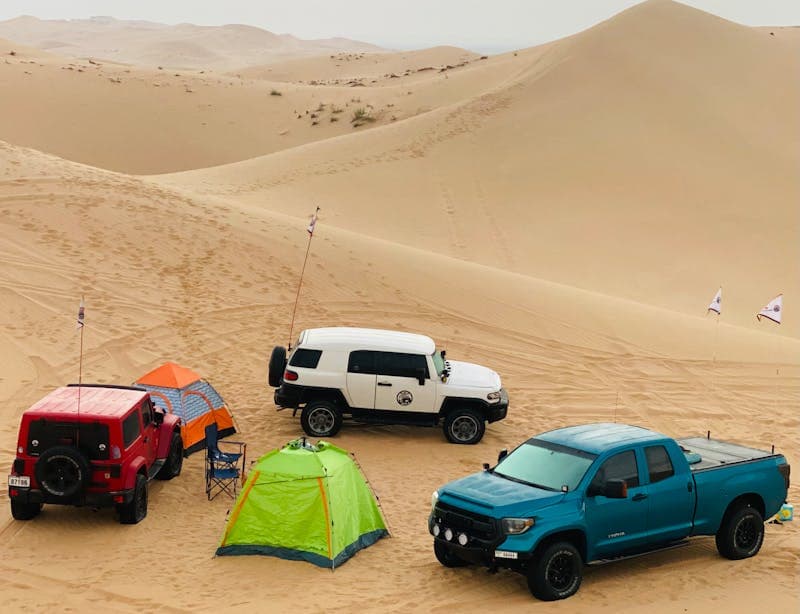
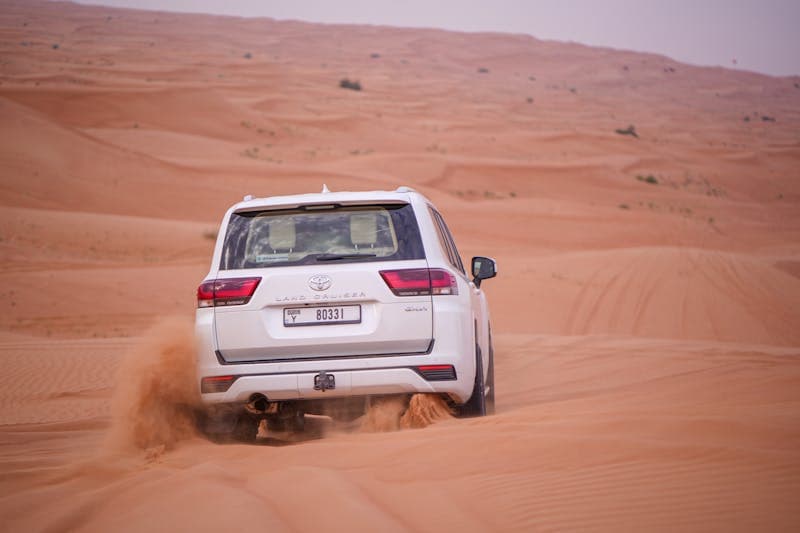
A 4x4 vehicle is essential for any camping trip that involves driving on sand. The most popular vehicles for desert driving in Saudi Arabia are the Toyota Land Cruiser, Toyota FJ Cruiser, Nissan Patrol, and Jeep Wrangler. The Land Cruiser is the undisputed king of Saudi desert driving and you will see them everywhere.
Tire deflation is the single most important technique for sand driving. Before entering soft sand, reduce your tire pressure to 15-18 PSI (from the normal 32-35 PSI). This dramatically increases the tire's contact area with the sand and prevents you from sinking. You will need a portable air compressor to reinflate before driving back on tarmac. A compressor costs 100-300 SAR and is an absolute must-have.
Key driving tips for sand: keep momentum - if you slow down on a dune, you will get stuck. Use low-range 4WD. Do not make sharp turns on soft sand. When climbing a dune, commit fully - stopping halfway is the fastest way to get buried. When descending, go straight down (never diagonally) and let the car roll in gear without braking hard.
Recovery gear you should carry: a tow rope (minimum 8-ton rated), sand ladders or MaxTrax recovery boards, a shovel (a compact folding shovel works), and a portable air compressor. A 12V tire inflator that plugs into your car's cigarette lighter is sufficient for most situations.
If you do not own a 4x4, you can rent one. Budget, Hertz, and Sixt all offer 4x4 rentals in Saudi Arabia. Expect to pay 300-600 SAR per day for a mid-size SUV with 4WD. Make sure the rental agreement allows off-road use - some companies restrict this. Alternatively, you can drive a regular car to the edge of the desert and camp in areas accessible by tarmac roads, which still gives you a great desert experience without the sand driving.
The golden rule: never go into the desert alone. Always travel in a convoy of at least two vehicles. If one gets stuck, the other can tow it out. If one breaks down, everyone can still get home safely. This is not optional advice - it is a genuine safety rule that experienced desert drivers follow religiously.
Choosing the right campsite matters more than you might think. Here is what to look for:
Wind shelter. Set up your tent on the leeward side of a dune (the side sheltered from wind). Even a small dune provides significant wind protection. Wind is the biggest comfort factor in desert camping - a sheltered spot is warm and pleasant while an exposed spot 50 meters away can be cold and miserable.
Flat, firm ground. Look for compacted sand rather than soft, powdery sand. Your tent will be more stable and you will not sink when walking around. Avoid camping on the crest of a dune - wind is strongest there.
Not in a wadi. A wadi (dry riverbed) looks like a flat, convenient camping spot, but it becomes a raging torrent when it rains. Even if there is no rain where you are, precipitation in mountains 31 miles (50 km) away can send water rushing through a wadi hours later. Camp above and away from any drainage channels.
The Saudi camp setup is typically more elaborate than Western-style camping. Many Saudi families lay out large carpets or rugs on the sand to create an outdoor living room. A separate fire pit area is set up for cooking and socializing. Tent(s) are for sleeping, while most of the evening is spent around the campfire. If you are invited to a Saudi family's desert camp, expect generous hospitality - Arabic coffee, dates, and often a full meal.
Tent stakes do not hold well in loose sand. Use sand anchors (bags you fill with sand and bury) or tie guy lines to heavy objects like water jugs or rocks. Alternatively, bury your regular tent stakes horizontally in the sand at a deep angle - this holds much better than vertical placement.
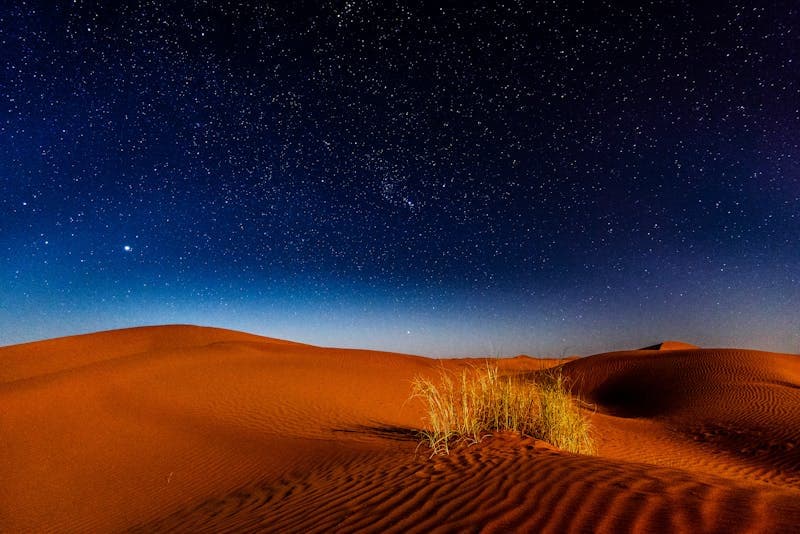
One of the greatest rewards of desert camping is the night sky. Saudi Arabia's deserts have minimal light pollution, zero cloud cover for most of the year, and extremely dry air - all of which combine to produce some of the clearest stargazing conditions on Earth. On a clear winter night, you can see the Milky Way stretching across the sky with your naked eye.
Best conditions: camp at least 31-50 miles (50-80 km) from any major city to escape light pollution. Check the lunar calendar and aim for nights around the new moon, when the sky is darkest. December through February offers the best visibility, with low humidity and long nights.
What you can see: the Milky Way, Orion (prominent in winter), the Pleiades star cluster, Jupiter and Saturn (visible to the naked eye as bright non-twinkling dots), and occasional meteor showers. The Geminid meteor shower in mid-December and the Perseids in August are the most spectacular annual events.
Equipment: you do not need a telescope to enjoy desert stargazing. Your naked eyes, adapted to darkness after 20-30 minutes without looking at phone screens, will reveal an astonishing number of stars. A pair of binoculars (10x50) significantly enhances the experience and reveals details in the Milky Way, star clusters, and the Andromeda galaxy. For serious stargazing, apps like Stellarium or Sky Map help identify what you are looking at.
Photography tip: modern smartphones (iPhone 15 Pro and newer, Samsung Galaxy S23 and newer) have night mode capable of capturing the Milky Way. Use a small phone tripod, set the longest exposure your phone allows, and point toward the brightest part of the Milky Way. For DSLR or mirrorless cameras, use a wide-angle lens, manual focus set to infinity, ISO 1600-3200, aperture f/2.8 or wider, and a 15-25 second exposure.
Desert camping is safe when you prepare properly. The risks are predictable and manageable. Here are the key safety rules:
Water. Dehydration is the number one risk in the desert. Bring at least 4-5 liters per person per day, and more if temperatures are above 30°C / 86°F. Keep water in your vehicle at all times. If you ever get stranded, stay with your vehicle (it is easier to spot than a person) and ration your water.
Navigation. Download offline maps (Google Maps allows offline area downloads, and Maps.me is excellent for desert tracks). Drop a GPS pin at your campsite before wandering off. The desert looks the same in every direction and it is surprisingly easy to get disoriented, especially at night or in a sandstorm. A physical compass is a useful backup.
Phone signal. Most popular camping areas near major cities have mobile phone coverage (STC has the broadest coverage in rural areas). However, once you go 100+ km from a city, signal can be patchy. Tell someone back home where you are going and when you expect to return. Share your live location via WhatsApp with a trusted contact.
Wildlife. Scorpions and snakes exist in Saudi deserts but encounters are uncommon. Shake out your shoes before putting them on in the morning. Do not leave sleeping bags or clothing on the ground unattended. Check inside your tent before entering. If you see a snake, back away slowly. The horned viper and saw-scaled viper are venomous species present in Saudi deserts, but they avoid humans and bites are rare.
Campfire safety. Keep fires a safe distance from tents and vehicles. Never leave a fire unattended. Fully extinguish fires with sand (not water, which you should not waste) before sleeping or leaving. Wind can pick up suddenly and scatter embers.
Emergency numbers: Police: 999. Ambulance: 997. Civil Defense (rescue): 998. Red Crescent: 997. Save these before heading out. In a true emergency, Saudi rescue services will come to the desert, but reaching your exact location can be slow. This is another reason to always camp with multiple vehicles and carry sufficient supplies.
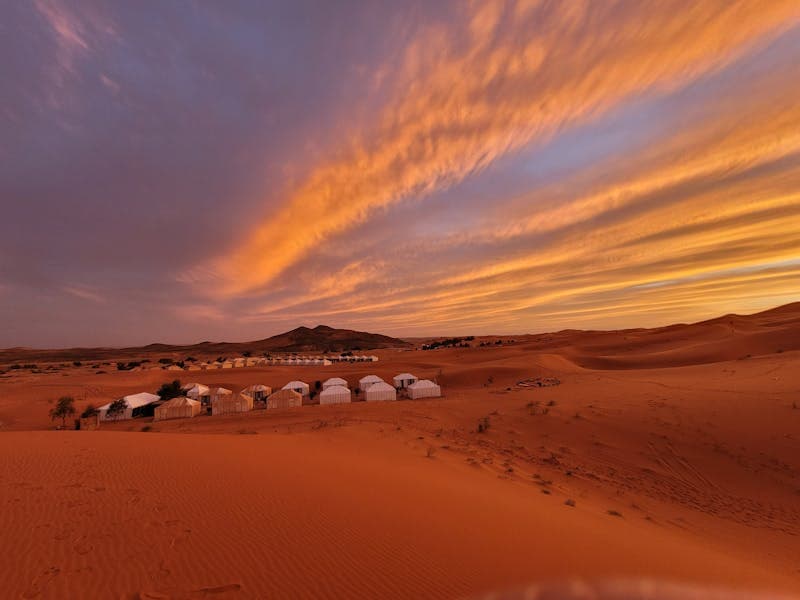
If pitching your own tent and driving a 4x4 through sand does not appeal to you, Saudi Arabia has a growing luxury camping (glamping) and organized tour market. This is a great way to experience the desert without the logistics.
AlUla has the most developed glamping scene. Habitas AlUla offers luxury tents with full en-suite bathrooms among the sandstone formations. Prices start around 3,000-5,000 SAR per night. The Royal Commission for AlUla also operates seasonal desert camps during the AlUla Moments festival season (October-March) with more accessible pricing. These camps include dinner, breakfast, cultural activities, and stargazing sessions.
Near Riyadh, several operators run weekend desert camping trips for expats. These typically include 4x4 transport from the city, camp setup, meals, campfire, and stargazing for 300-800 SAR per person. Search for operators on Instagram (search Saudi camping experiences) or ask in expat Facebook groups. Some compounds and embassy social clubs organize regular desert camping trips for their communities.
Dune bashing tours are another option. Multiple operators in Riyadh and the Eastern Province offer half-day or full-day 4x4 desert experiences that include dune driving, sandboarding, and a BBQ lunch or dinner in the desert. Prices range from 200-500 SAR per person. These are fun but give you less of the authentic overnight camping experience.
Empty Quarter expeditions are organized by specialty tour operators and typically last 3-7 days. These guided trips take you deep into the Rub al-Khali with all equipment, food, and expert desert guides provided. Expect to pay 5,000-15,000 SAR per person depending on duration and group size. This is the ultimate Saudi desert experience but requires commitment and a reasonable level of fitness.
Desert ecosystems are fragile and slow to recover. A tire track in the desert can remain visible for years. Trash left behind does not decompose in the dry climate - it sits there indefinitely. Unfortunately, littering is a significant problem at popular camping sites around Riyadh and other cities, with some areas becoming quite degraded.
Be part of the solution, not the problem. Pack out everything you bring in. This includes food waste, cigarette butts, bottle caps, and any broken gear. Bring extra trash bags and fill them. If you feel motivated, pick up some litter left by others - many camping groups now organize regular desert cleanup events.
Bury human waste at least 15 cm deep and 50 meters from any water source or camping area. Pack out toilet paper in a sealed bag. Do not burn it - this is a fire hazard in dry desert vegetation.
Respect wildlife. Do not chase or disturb desert animals. Camels, oryx, foxes, and various reptiles call this desert home. Drive on existing tracks where possible to minimize habitat disruption. If you see rare wildlife (Arabian oryx, sand cats, bustards), observe from a distance and consider reporting sightings to the Saudi Wildlife Authority.
Desert camping is just one of many adventures waiting in the Kingdom. Discover the best cities, seasonal travel tips, and outdoor activities.