
Loading...
Join our Facebook Group: Join: Expats in Saudi Arabia
Loading...
Moving to Saudi Arabia or visiting as a woman? This guide is written for expat and tourist women, not about Saudi women's lives. It covers what you actually need to know: what to wear (and what's just a myth), how safe it really is, what working here looks like, how to get around independently, and what daily life feels like on the ground. Honest, practical, and based on the reality of 2026, not the stereotypes.
If your image of Saudi Arabia comes from news stories ten years ago, it is outdated. Between 2017 and 2019, the Kingdom introduced a wave of social reforms that fundamentally restructured daily life for all women, both Saudi citizens and the millions of foreign women who live, work, and travel in the country. Women gained the right to drive in June 2018, ending one of the most internationally recognized restrictions. A year later, in August 2019, women over 21 were granted the ability to obtain passports and travel abroad without needing male guardian permission. In the same period, cinemas reopened after a 35-year ban, concerts and mixed-gender public events became legal, and entertainment venues began welcoming women alongside men for the first time.
The changes extended well beyond entertainment and travel. Women gained access to virtually all employment sectors, including retail, hospitality, and law, areas where they had previously been barred from working. They could now register their own businesses, access government services independently, and serve as legal guardians for their children for administrative purposes. The abaya, the loose black robe that had been mandatory in public for decades, was officially no longer required by law, though modest dress remained a social expectation. Taken together, these reforms were not incremental adjustments. They represented a deliberate, government-driven restructuring of the social contract.
A woman arriving in Saudi Arabia in 2026 will find a country where she can rent her own apartment, drive to work, eat alone at any restaurant, attend a football match, and fly across the country without anyone questioning her right to do so. Five years ago, most of this was either illegal or socially impossible. The contrast is stark, and it is worth appreciating just how fast the shift has been, because no other country in the region has attempted reforms of this scale and speed.
That said, it is important to be honest about what has not changed. Saudi Arabia remains a deeply conservative society rooted in Islamic values and tribal traditions. The legal reforms have expanded what women can do, but social expectations still vary enormously depending on where you are, who you are with, and the context. Jeddah, the port city on the Red Sea, has always been more cosmopolitan and relaxed. Riyadh, the capital, is more moderate but still noticeably conservative in certain neighborhoods. Smaller cities and rural areas operate by older social norms where an unaccompanied woman in Western clothing will attract stares and questions. Expat women generally enjoy more social freedom than Saudi women, but understanding and respecting local customs matters everywhere, not because you will be punished for breaking them, but because you will have a much better experience when you work within the culture rather than against it.
The honest framing is this: Saudi Arabia is not Scandinavia, and it is not trying to be. But it is also not the place that most outsiders imagine when they hear the name. The reality in 2026 sits somewhere in between, and the overwhelming majority of expat women report being surprised by how comfortable, safe, and independent their daily lives actually are once they settle in and learn how things work.
By virtually every measurable criterion, Saudi Arabia is one of the safest countries in the world for women when it comes to violent crime. Robbery, mugging, assault, and street crime are extraordinarily rare. The country maintains a large and visible police presence, extensive CCTV networks in urban areas, and enforces severe penalties for violent offenses. Violent crime statistics are consistently among the lowest globally, and the gap between Saudi Arabia and most Western cities in this regard is significant. It is common to hear expat women say, without exaggeration, that they feel safer walking through Riyadh at midnight than they ever did in London, New York, or Paris.
Street harassment, which is a separate issue from violent crime, is uncommon in most areas but not non-existent. Catcalling, following, and inappropriate staring do occur occasionally, particularly from young men in cars in quieter neighborhoods or on less busy streets. Shopping malls, busy commercial districts, and tourist areas are almost always hassle-free. The situation has improved markedly in recent years due to a combination of stricter enforcement, public awareness campaigns, and a genuine cultural shift driven partly by the fact that more women are present in public spaces than ever before. When harassment does happen, it is almost always limited to verbal comments or staring rather than anything physical, and Saudi police take complaints from women seriously.
Ride-hailing apps have transformed how women move around Saudi cities. Uber and Careem operate nationwide and are the default transport choice for millions of women, both Saudi and expat. Both apps display the driver's name, photo, license plate, and vehicle model before you get in, and every ride is GPS-tracked in real time. You can share your ride status with a trusted contact. Many expat women rely on ride-hailing as their primary transport for months before they get comfortable driving, and it is considered completely safe and socially normal for women to travel alone by app.
Walking alone during the day is safe in all major cities, and evening walks are also generally safe in busy, well-lit areas. The Riyadh Boulevard, Jeddah Corniche, Al Khobar Corniche, and city center shopping districts are routinely full of families and women walking alone after dark. Use the same common-sense precautions you would apply anywhere: stick to populated areas, be aware of your surroundings, and avoid poorly lit, deserted streets late at night. The Riyadh Metro, which opened in 2024, has designated women-only sections in every train, and SAPTCO intercity buses offer women-only seating areas. These are optional, not mandatory, but they are there for anyone who prefers them.
Dress code is probably the topic that generates the most confusion, partly because many guides mix up what applies to Saudi women with what applies to foreign visitors and expats. The two experiences are quite different, so let's separate them clearly.
As a foreign woman, you are not required to wear an abaya, a headscarf, or any traditional Saudi clothing. This changed in 2019, and it applies equally to tourists on short visits and to expat residents. You are free to wear your own clothes in public, provided they are reasonably modest. In practice, "modest" means loose-fitting garments that cover the shoulders and knees. You do not need to cover your hair at any point, unless you are entering a mosque. Long sleeves are not mandatory in most everyday settings. The best way to think about it is "smart modest": the kind of outfit you might wear to a conservative workplace or a family gathering back home. Linen trousers and a loose blouse, a midi dress, a long skirt with a T-shirt, these all work perfectly well in any Saudi city.
What you should avoid in public spaces are very short skirts, crop tops, low-cut necklines, transparent fabrics, and skin-tight clothing. These will attract unwanted stares and are considered disrespectful in a culture that values modesty. Nobody will arrest you, but you will stand out in a way that makes daily life less comfortable. On residential compounds, none of this applies. Inside compound walls, you can wear shorts, tank tops, swimwear at the pool, and whatever you want. At private and resort beaches (NEOM, Red Sea resorts, KAEC), swimwear is completely normal. Inside women-only gyms, wear whatever activewear you prefer, exactly as you would at home.
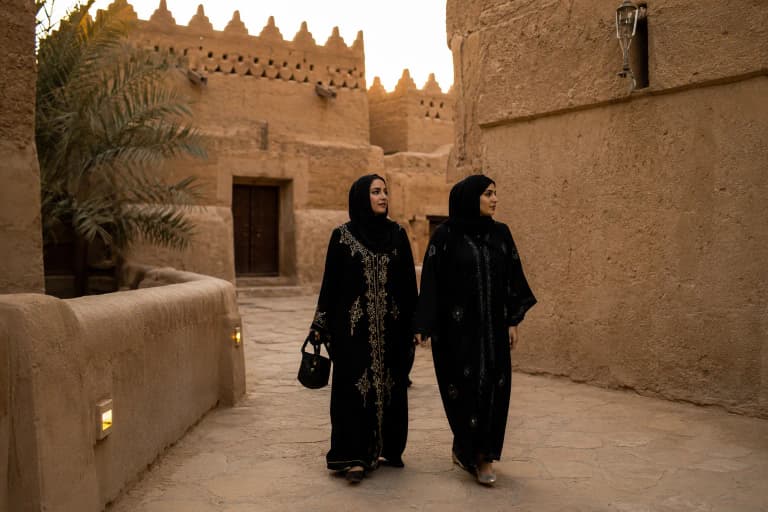
To understand the context you are living in, it helps to know what your Saudi neighbors and colleagues wear. Many Saudi women still wear the abaya in public, but increasingly as a fashion choice rather than a legal obligation. In Jeddah, you will see Saudi women in abayas of every color and design, as well as many without one at all. In Riyadh, the abaya is more common but designer and colored styles have largely replaced the plain black version. Headscarves are a personal and family decision. Some Saudi women cover their hair, some do not. In corporate and professional settings, Saudi women typically wear international business attire underneath the abaya and remove it at the office. The point is that even among Saudi women, dress is far more varied and personal than most outsiders expect, and the monolithic image of "all women in black" has not been accurate for years.
Jeddah is the most relaxed city. Expat women in casual modest clothing (trousers, tunics, long-sleeved tops) blend in without a second glance. You will see both Saudi and expat women without abayas or headscarves in malls, cafes, and on the Corniche. Riyadh is more moderate. Loose, modest Western clothing is fine everywhere, but the overall atmosphere is more conservative than Jeddah, and very casual outfits might draw an occasional look, particularly in older neighborhoods. In upscale areas like the Diplomatic Quarter and Al Olaya, the norms are more relaxed. Tourism-oriented areas like NEOM, Red Sea resorts, and AlUla are intentionally designed for international visitors, and casual vacation clothing is entirely normal. Smaller cities and rural areasare a different experience. In Ha'il, rural Tabuk, or villages in the Asir region, you will stand out as a foreigner regardless of what you wear, and putting on a lightweight abaya will earn you warmer reception and fewer stares, not because it is required, but because it is a gesture of respect for local customs that people genuinely appreciate.
Keep a lightweight abaya in your bag or car. They cost 100-300 SAR at any mall and fold down to almost nothing. It is useful for visiting government offices, entering mosques, going to more conservative neighborhoods, or any situation where you want to blend in without thinking about your outfit. Think of it as a practical tool, not an obligation. Most expat women end up owning at least one, and many come to appreciate the simplicity of throwing it on for quick errands in conservative areas.
The transformation of the Saudi labor market for women is one of the most striking aspects of Vision 2030. Female workforce participation has more than doubled, jumping from around 17% in 2017 to over 35% in 2026. The government's stated goal is to reach 40% by 2030, and they are using a combination of legislation, financial incentives for employers, and direct government hiring to get there. Companies across all sectors are under genuine pressure to recruit, retain, and promote women, and the result is a labor market that actively wants female talent in a way that would have been unthinkable a decade ago.
The sectors with the strongest demand for women are healthcare (nursing, pharmacy, and especially OB/GYN, pediatrics, and dermatology), education at all levels from kindergarten to university, finance and banking where Saudi banks have aggressively hired women into client-facing, advisory, and management positions, and technology including software development, cybersecurity, data science, and UX design. Retail and hospitality, which were entirely closed to women until recent years, are now hiring rapidly, and the new entertainment sector encompassing concerts, festivals, theme parks, and tourism employs thousands of women across the Kingdom.
Mixed-gender workplaces have become the standard in the private sector and are increasingly common in government roles as well. The atmosphere in most offices is similar to what you would find in Dubai, Bahrain, or any other international business environment in the Gulf. There is no legal requirement for gender-segregated offices, and while some traditional family-owned businesses may maintain separate work areas, most multinational companies and modern Saudi firms operate fully mixed environments where men and women work side by side in meetings, open offices, and client interactions.
Saudi labor law provides important protections for working women. Equal pay for equal work is mandated regardless of gender. Maternity leave is 10 weeks at full pay, extendable to 12 weeks, and nursing breaks during work hours are a legal right for the first two years after the birth of a child. Workplace harassment is a criminal offense with serious penalties. These protections are generally well-enforced, particularly in larger companies and multinational firms where HR departments are well-established and compliance is closely monitored.
For a deeper look at workplace norms, meeting culture, hierarchies, and business etiquette that applies to everyone working in the Kingdom, see our working culture guide.
Day-to-day life for women in Saudi Arabia is considerably more independent and straightforward than most newcomers expect. The practical aspects of living, from managing your own finances to moving around the city, are now largely indistinguishable from what you would experience in other modern Gulf countries, and in many ways the infrastructure is newer and more efficient.
Women drive everywhere in Saudi Arabia in 2026, and the only real challenge is the traffic, not social attitudes. If you hold a valid driving license from your home country, you can exchange it for a Saudi license through a straightforward process that, for most nationalities, does not require a driving test. If your country is not on the recognized list, you can take driving lessons at a Saudi driving school and pass the practical test. Car rental is available to women at every major airport and city center location without any restrictions or additional requirements. Most expat women are driving independently within their first month of arriving. For the full step-by-step process, see our driving license guide.
As for Saudi women, driving has been legal since 2018 and many have enthusiastically embraced it, especially younger women in cities like Riyadh and Jeddah. That said, not every Saudi woman drives. In more conservative families or smaller towns, some women still prefer to rely on a private driver or family member for transportation, which is a personal or cultural choice rather than a legal restriction. Having a private driver remains common across Saudi society regardless of gender, particularly among wealthier families. You will see plenty of Saudi women behind the wheel in daily traffic, but do not be surprised if your Saudi colleague or neighbor has a driver. It is simply part of the culture here and carries no stigma either way.
Women open and manage bank accounts entirely independently. There is no guardian signature required, no permission slips, no co-signer needed. You walk into any bank branch with your Iqama (residence permit) and your passport, fill out the application, and your account is set up. Online banking, credit cards, debit cards, investment accounts, and money transfers are all available to women without any restrictions or additional approvals. The process is identical to what a man would go through. For the step-by-step process of opening an account, see our banking guide.
Women can rent apartments and villas independently, and there is no legal requirement for a male guarantor or co-signer on a lease. In practice, some older landlords who manage their own properties directly might prefer renting to families, but this attitude is becoming less common every year. If you are renting through a property management company, a real estate platform like Bayut or Aqar, or in a modern apartment building, being a single woman tenant is a non-issue. Compounds, which are popular with many expat women for their built-in community and amenities, are accustomed to single female residents. Our renting guide covers the entire process including contracts, deposits, and tenant rights.
The old system of mandatory "family sections" and "singles sections" in restaurants is gone. Restaurants no longer segregate seating, especially in Riyadh and Jeddah. Women can eat at any restaurant, sit at any table, and visit cafes alone or with friends without being directed to a separate area. Cinemas, concerts, festivals, comedy shows, theme parks, museums, and sporting events, including football matches and motorsport, are all open to women. The Saudi entertainment scene has grown explosively since the entertainment authority was established in 2016, and weekend options in Riyadh and Jeddah now include everything from art exhibitions and live music to food festivals and outdoor adventures. For many expat women, the social calendar is busier than they expected.
The women-only fitness industry is booming. Large chain gyms like Leejam Sports (Fitness Time) and NuYu operate women-only branches in every major city with full equipment, group fitness classes, swimming pools, and spa facilities. Beyond the chains, there is a growing ecosystem of boutique studios offering yoga, Pilates, barre, CrossFit, boxing, and martial arts classes for women. Running groups and outdoor fitness communities for women have become popular, especially in Riyadh and Jeddah where park facilities have improved dramatically. Beauty salons and spas are ubiquitous and women-only by default, with standards and variety comparable to any major international city.
The Saudi healthcare system is well-funded and modern, and services related to women's health are among its strongest areas. The Kingdom has invested heavily in hospital infrastructure, medical training, and attracting international healthcare professionals, and the result is a system where women can access high-quality care for everything from routine check-ups to complex medical procedures.
Maternity services are a genuine strength of Saudi healthcare. Major hospitals, both public and private, have dedicated maternity wards equipped with modern technology, neonatal intensive care units, and experienced staff. Finding a female OB/GYN for prenatal care and delivery is straightforward, as many Saudi and international female specialists practice in the Kingdom. If having a female doctor is important to you, you will have plenty of options. Private hospitals popular among expat women include Dr. Sulaiman Al Habib Medical Group, Saudi German Hospital, Kingdom Hospital, and King Faisal Specialist Hospital and Research Centre. Prenatal care follows international protocols, and the standard of maternity rooms and postnatal care in private hospitals is generally excellent.
Contraceptive pills, IUDs, implants, and other birth control methods are available at pharmacies and through gynecologists. You do not need a prescription for basic oral contraceptives at most pharmacies, though consulting a doctor is recommended for choosing the right option. Fertility treatments including IVF and IUI are widely available at specialized clinics in Riyadh, Jeddah, and the Eastern Province, though these services are restricted to married couples. Routine gynecological care including screenings, ultrasounds, and consultations is accessible through any hospital with an obstetrics and gynecology department.
Mental health services have expanded significantly in recent years, reflecting both increased demand and a gradual reduction in the stigma that has historically surrounded mental healthcare in Saudi society. Psychologists, psychiatrists, and counselors practice in all major cities, and many speak fluent English. Private hospitals and standalone clinics offer therapy, counseling, and psychiatric services. The field is still developing compared to Western countries, and there can be longer wait times for specialists, but the quality of care is generally good. Several online therapy platforms also operate in Saudi Arabia, which some expat women find more accessible and convenient, especially for English-language counseling.
Health insurance is mandatory for all residents of Saudi Arabia, and your employer is required to provide it. Standard employer-provided insurance typically covers maternity care, gynecological consultations, and mental health services, but the details vary by plan. One important consideration: some insurance policies have a waiting period of up to 12 months before maternity benefits kick in, so if pregnancy is on your horizon, check your policy carefully and ask about this specifically when negotiating your employment package. For comprehensive information about how insurance works in the Kingdom, see our insurance guide, and for a broader overview of the healthcare system, see our healthcare guide.
Solo female travel in Saudi Arabia is not just possible, it is genuinely easy and safe. The infrastructure supports independent travelers well, Saudi hospitality toward guests is deeply culturally ingrained, and the legal and logistical barriers that previously made solo female travel difficult were removed in 2019. A growing number of women, both residents and international tourists, are exploring the Kingdom on their own, and the tourism infrastructure has improved dramatically to accommodate them.
Hotels accept solo female guests without any issues. International chains like Marriott, Hilton, IHG, and Accor, as well as local boutique hotels, will check you in without questions about a male companion and without requiring any additional documentation. Budget options, including guesthouses and Airbnb-style rentals through Gathern (the Saudi equivalent of Airbnb), are also available to solo women without restriction. In smaller towns, guesthouse owners may be slightly less accustomed to solo female travelers, but they will still accommodate you without any problems. The only exception is accommodation in Mecca, where non-Muslims are not permitted regardless of gender.
Domestic flights are frequent, affordable, and the easiest way to cover Saudi Arabia's vast distances. Saudia, flynas, and flyadeal operate routes connecting all major cities, with flights between Riyadh and Jeddah running almost hourly. The Haramain High-Speed Railway connects Mecca, Medina, Jeddah, and King Abdullah Economic City with modern, comfortable trains that are a pleasure to ride. Saudi Arabia Railways (SAR) operates the Riyadh-to-Dammam route through the Eastern Province. Car rental is available to women at all major airports and in city centers, making road trips entirely feasible. And ride-hailing apps, Uber and Careem, work in every city and are the most convenient option for getting around locally.
All forms of public transport in Saudi Arabia are safe for women. The Riyadh Metro includes women-only carriages in every train, providing a comfortable option for those who prefer it. Intercity buses operated by SAPTCO have designated women-only seating areas. Train travel on both the Haramain and SAR lines is modern, clean, and comfortable. Uber and Careem remain the easiest and most flexible option for local transport, and both are widely considered safe and reliable for women traveling alone at any hour.
The rules for women in Saudi Arabia have relaxed dramatically since 2018. Women can now drive, travel, work in almost any profession, rent a home, open a bank account, and run a business independently. Women over 21 no longer need male guardian permission to obtain a passport or travel. The abaya is no longer legally required, though modest dress is expected in public. For foreign women (both residents and tourists), the practical rules are simple: dress modestly (cover shoulders and knees, no need to cover your hair outside mosques), avoid public displays of affection, do not drink alcohol (it is banned nationwide), and dress more conservatively during Ramadan. Beyond that, daily life is far more independent than most newcomers expect.
There is no strict legal dress code for foreign women in Saudi Arabia. Since 2019, the abaya (the long black robe) is no longer legally required, and tourists and expat women are not obliged to wear one or cover their hair. The expectation is modest clothing: loose-fitting outfits that cover the shoulders and knees. Long sleeves are not mandatory in most everyday settings, and you only need to cover your hair when entering a mosque. Avoid very short skirts, crop tops, low necklines, transparent fabrics, and skin-tight clothing in public. Jeddah is the most relaxed city, Riyadh is slightly more conservative, and smaller towns are more traditional, where a lightweight abaya helps you blend in. On residential compounds and at private or resort beaches, normal Western clothing and swimwear are fine.
Yes. Women have been legally allowed to drive in Saudi Arabia since June 2018, when the decades-long ban was lifted. This applies to Saudi women, expat residents, and visitors alike. If you hold a valid driving license from your home country, you can exchange it for a Saudi license without a driving test for most nationalities; otherwise you can take lessons and pass the Saudi test. Car rental is available to women at every major airport and city center without restrictions, and ride-hailing apps like Uber and Careem are widely used and considered safe for women traveling alone.
Yes. Since 2019, women over 21 no longer need male guardian permission to travel, and solo female travel within Saudi Arabia is safe and straightforward. Women can book hotels, fly domestically, ride the Haramain high-speed train, rent cars, and take taxis on their own without being questioned. Hotels check in solo female guests without requiring a male companion or proof of marriage. The main exception is Mecca, which is closed to non-Muslims regardless of gender. Solo female tourists visit destinations like AlUla, Jeddah, Riyadh, and the Red Sea coast independently, and the tourism infrastructure is well set up for them.
No. As of 2019, the abaya is no longer legally required for women in Saudi Arabia, including foreign visitors. However, you should dress modestly: loose clothing covering shoulders and knees is expected everywhere. In Jeddah, you can get away with a long-sleeved top and loose trousers. In Riyadh, slightly more conservative dress is the norm. In smaller towns and rural areas, wearing an abaya will help you blend in and avoid unwanted attention. Many expat women keep a lightweight abaya in their bag for situations where it feels appropriate.
Yes. Women have been legally allowed to drive in Saudi Arabia since June 2018. If you hold a valid driving license from your home country, you can exchange it for a Saudi license without taking a driving test (for most nationalities). If not, you can take driving lessons and pass the Saudi driving test. Ride-hailing apps like Uber and Careem are also widely available and safe for women traveling alone.
Saudi Arabia has extremely low rates of violent crime and street crime compared to most Western countries. Many expat women walk alone in the evenings in Riyadh, Jeddah, and other major cities without issues. That said, use common sense as you would anywhere: stick to well-lit areas, avoid completely deserted streets late at night, and be aware of your surroundings. The Riyadh Boulevard, Jeddah Corniche, and city center areas are generally busy and safe even after dark.
Yes. Since 2019, women over 21 no longer need male guardian permission to travel. You can book hotels, fly domestically, rent cars, and take trains on your own. Solo female tourists visit Saudi Arabia regularly and travel independently without any issues. Hotels will not question a woman checking in alone.
Yes, and the options are growing fast. Women-only gyms are available in all major cities, ranging from boutique fitness studios to large chain gyms like Leejam Sports (Fitness Time) and NuYu. Many residential compounds have separate pool hours or dedicated women-only pool facilities. Women-only yoga and Pilates studios are popular in Riyadh and Jeddah. Some public beaches have designated women-only days or sections.
Almost. Saudi Arabia has removed most legal restrictions on women working. Women now work in retail, hospitality, law, engineering, medicine, finance, tech, government, and many other sectors. A few roles in specific military and security positions remain restricted. Vision 2030 has aggressively pushed female workforce participation, and companies actively recruit women to meet government targets. The female workforce participation rate has jumped from around 17% in 2017 to over 35% in 2026.
Ramadan rules apply equally to men and women. Non-Muslims are not required to fast, but everyone must avoid eating, drinking, and smoking in public during daylight hours throughout Ramadan. Dress more conservatively than usual during this month. Restaurants close during the day but many offer takeaway or have screened-off areas. Work hours are typically shortened. The evenings come alive with iftar gatherings and late-night socializing. It is a genuinely unique cultural experience worth embracing.

Social Life and Community
Building a social life as a woman in Saudi Arabia is considerably easier than it was even five years ago, though it does take some proactive effort in the beginning, as it does with any international move. The expat community is large, active, and generally very welcoming to newcomers. The opening of entertainment venues, restaurants, and public spaces has created far more opportunities for socializing than existed before, and the combination of a strong expat network and a growing Saudi social scene means that most women find their footing within a few months of arriving.
Expat Women's Groups
Every major city in Saudi Arabia has multiple active expat women's groups that organize regular events ranging from casual brunches and coffee mornings to book clubs, hiking excursions, sports leagues, cultural outings, and charity events. These groups operate primarily through Facebook, WhatsApp, and Instagram, and they are typically the fastest and most effective way to build a social circle when you first arrive. Some groups are organized by nationality, like British Women in Riyadh or American Women in Jeddah, while others are built around shared interests such as hiking, photography, yoga, cooking, or art. Many long-term expat women credit these groups with making their early months in the Kingdom dramatically more enjoyable.
Compound Life
Many expat families and a significant number of single expats live in residential compounds, which function as self-contained communities behind walls, complete with swimming pools, gyms, tennis courts, playgrounds, social clubs, and sometimes restaurants and shops. Compounds are particularly popular with families and with women who want a ready-made social network and a relaxed environment where dress code expectations do not apply. Inside compound walls, you can wear shorts, tank tops, and swimwear without any concern. The social atmosphere tends to be tight-knit, with regular community events, pool parties, holiday celebrations, and informal gatherings. For a deeper look at what compound life involves, including how to choose the right one and what to expect, see our compound living guide.
Making Connections Beyond Organized Groups
Saudi Arabia's cafe culture is a natural and increasingly important meeting point for both expat and Saudi women. The specialty coffee scene in Riyadh and Jeddah is genuinely world-class, with hundreds of independent cafes that serve as informal workspaces, study spots, and social gathering places. Many women use a regular cafe as their "third place" between home and work, and it is not unusual to strike up conversations and build friendships through repeated visits. Beyond cafes, co-working spaces, fitness classes, hobby groups like photography walks and cooking classes, and volunteer organizations are all effective ways to meet people. Saudi women in their twenties and thirties are increasingly open to friendships with expats, and the social boundaries between Saudi and non-Saudi women have become much more porous in recent years.
Dating
Dating exists in Saudi Arabia, but it operates under a very different set of rules than in Western countries. Public displays of affection, even something as mild as holding hands, are not socially acceptable and can attract attention or, in rare cases, legal consequences. Dating apps do operate in the Kingdom and people do meet privately, but the entire culture around romantic relationships is discreet rather than open. As part of the tourism reforms, hotels no longer require proof of marriage from foreign guests, so sharing a room as an unmarried couple is not an issue in practice. Understanding these boundaries is important for anyone navigating the social and romantic scene. The culture is evolving, especially among younger Saudis in major cities, but the overall framework remains conservative by Western standards.