Loading...
Join our Facebook Group: Join: Expats in Saudi Arabia
Loading...
Everything you need to know about the holiest site in Islam. History, architecture, rituals, and practical information for pilgrims and visitors.
By How to Saudi Arabia Editorial Team · Last updated:
Masjid al-Haram (Arabic: المسجد الحرام, "The Sacred Mosque"), also known as the Grand Mosque of Mecca, is the largest and holiest mosque in the world, a vast complex in the heart of Mecca that surrounds the Kaaba, the cube-shaped structure that every Muslim on Earth faces during their five daily prayers and the point toward which 1.8 billion people orient their spiritual lives.
Every year, millions of Muslims travel to Masjid al-Haram to perform Umrah (the lesser pilgrimage, which can be undertaken at any time of year) and Hajj (the annual pilgrimage that stands as one of the Five Pillars of Islam, required of every able-bodied Muslim at least once in their lifetime), and during the Hajj season over 2 million pilgrims gather simultaneously in and around the mosque, making it the largest annual human gathering anywhere on Earth. According to Islamic tradition, a single prayer performed within Masjid al-Haram carries the reward of 100,000 prayersperformed elsewhere, a belief that underscores the mosque's supreme and unmatched significance in the Muslim world.
Access restriction:
Masjid al-Haram and the entire city of Mecca are restricted to Muslims only. Non-Muslims are not permitted to enter under any circumstances, and this is strictly enforced with checkpoints on all roads leading into the city.
The history of Masjid al-Haram is inseparable from the history of the Kaaba and the history of Islam itself, stretching back thousands of years to the earliest foundations of monotheistic worship on the Arabian Peninsula.
Islamic tradition holds that the Kaaba was originally built by Prophet Ibrahim (Abraham) and his son Ismail (Ishmael) as a house of worship dedicated to the One God, with the Quran describing Ibrahim raising the foundations of the structure and calling people to make pilgrimage there. In the centuries that followed, the Kaaba became a centre of worship for the tribes of Arabia, eventually housing 360 idols representing the various deities of the pre-Islamic period.
In 630 CE, Prophet Muhammad conquered Mecca and cleansed the Kaaba of its idols, rededicating it to the worship of one God (Allah), though the area around the structure was initially just an open courtyard without any formal mosque architecture. The first walls were constructed around the courtyard by Caliph Omar ibn al-Khattab in 638 CE, who also added lighting to the space, and Caliph Uthman ibn Affan expanded it further in 647 CE by adding covered prayer areas supported by teak wood columns.
The mosque has been rebuilt and expanded numerous times over the centuries, each ruler leaving their mark on the structure. In 692 CE, Caliph Abd al-Malik ibn Marwan rebuilt the mosque after damage from the siege of Mecca, adding marble columns and mosaics, and between 775 and 785 CE, Abbasid Caliph al-Mahdi nearly doubled its size and incorporated the Mas'a (the Sa'i corridor between Safa and Marwa) into the mosque complex for the first time. The Ottoman period brought further transformation when Sultan Selim II renovated the mosque in 1571, replacing flat roofs with domes and adding the distinctive Ottoman-style minarets that defined its skyline for centuries.
The most dramatic changes came under Saudi rule. The first Saudi expansion (1955-1973) under Kings Saud and Faisal added new wings, two additional floors, and a rebuilt Mas'a gallery, while the Mataf area was paved with specially treated heat-resistant marble. King Fahd's expansion (1982-1988) added exterior prayer areas, the King Fahd Gate entrance, escalators, and full air conditioning, bringing the capacity to 800,000 worshippers. The ongoing expansion launched in 2007is the largest in the mosque's entire history and is expected to increase the total capacity to over 2.5 million people.
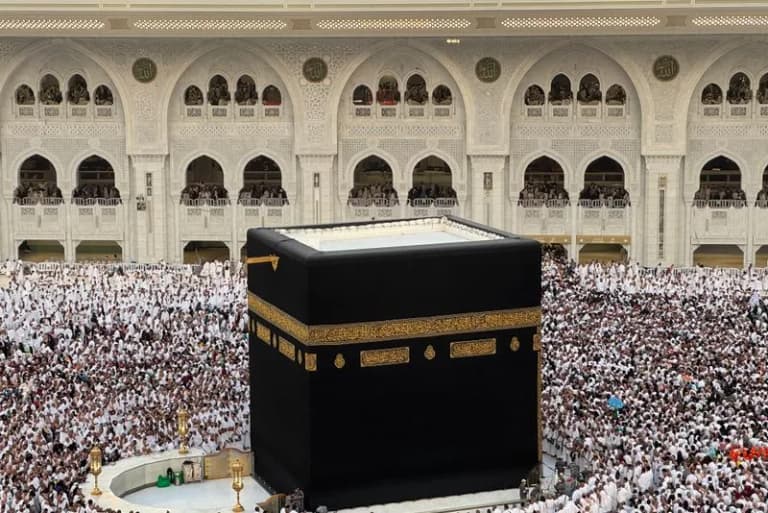
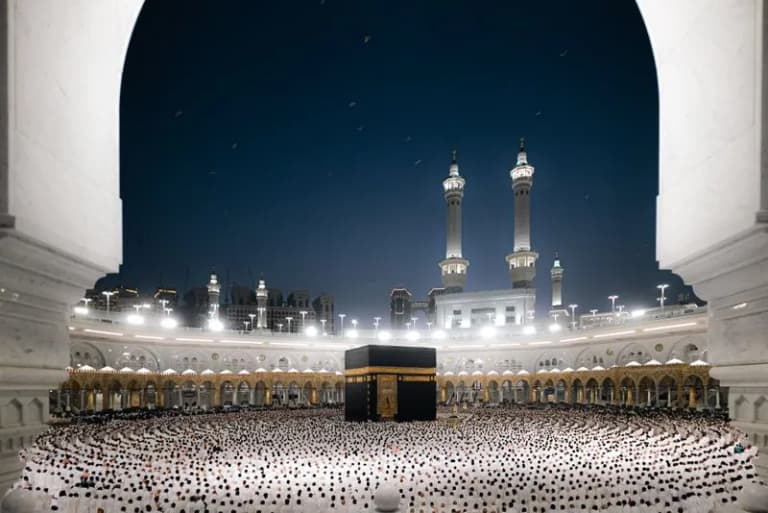
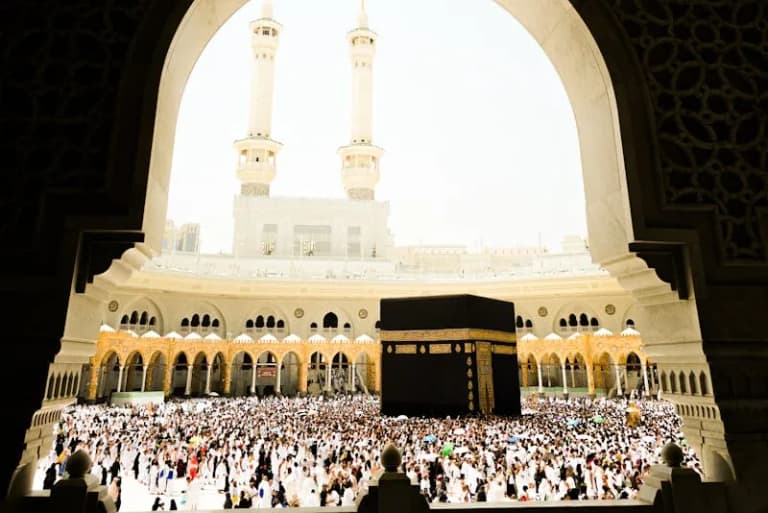
The Kaaba(Arabic: الكعبة, "The Cube") is the focal point of Masjid al-Haram and the most sacred site in Islam, standing at the centre of the Mataf, the vast open marble area where the Tawaf ritual is performed by millions of pilgrims throughout the year.
Given its enormous spiritual significance, the Kaaba is surprisingly modest in physical size, measuring approximately 43 feet (13.1 m) high, 36 feet (11.03 m) wide, and 42 feet (12.86 m) long, and is constructed from granite blocks quarried from the surrounding hills. The interior is a marble-floored room accessed through a gold door known as Bab al-Kaaba, which is set 7 feet (2.13 m) above ground level, and it is cleaned twice a year in a special ceremony attended by dignitaries, using Zamzam water and oud perfume in a tradition that has been maintained for centuries.
The Kaaba is draped in the Kiswah, a striking black silk cloth embroidered with gold Quranic calligraphy that is produced fresh every year by the dedicated Kiswah Factory in Mecca, requiring approximately 670 kg of silk, 150 kg of gold thread, and 120 kg of silver thread at a cost exceeding 20 million SAR. A band of calligraphy around the upper portion displays verses from the Quran in elegant Thuluth script, and when the old Kiswah is removed each year it is cut into pieces and gifted to dignitaries and Islamic institutions around the world.
Set into the eastern corner of the Kaaba at chest height, the Black Stone is an ancient and deeply revered stone that marks the starting and ending point of each circuit of Tawaf. Islamic tradition attributes its origin to the time of Adam and its placement in the Kaaba to Prophet Ibrahim, and the stone itself, now fragmented into several pieces bound together by a silver frame, is dark reddish-brown with a polished surface that has been smoothed by billions of kisses and touches over the course of many centuries.
Near the Kaaba stands Maqam Ibrahim(Station of Abraham), a small glass and gold enclosure containing a stone believed to bear the footprints of Prophet Ibrahim from when he stood on it while building the Kaaba. After completing their Tawaf, pilgrims pray two rak'ahs (prayer units) behind the Maqam Ibrahim, following the Quranic instruction: "And take the Station of Abraham as a place of prayer" (2:125).
The Hijr Ismail (also called Hateem) is a semi-circular white marble wall adjacent to the northwestern side of the Kaaba, and Islamic tradition holds that Ismail and his mother Hajar (Hagar) are buried beneath it. The area enclosed by the Hijr is considered part of the Kaaba itself, which means that praying within its boundaries carries the same spiritual weight as praying inside the Kaaba, and during Tawaf pilgrims must walk around the outside of the Hijr rather than cutting through it.
Modern Masjid al-Haram is an extraordinary feat of engineering and architecture that blends centuries of Islamic tradition with cutting-edge technology to accommodate millions of worshippers in a single space, and understanding its layout helps pilgrims navigate the complex with confidence.
The Matafis the gleaming white marble area immediately surrounding the Kaaba where the Tawaf ritual is performed, and following significant recent expansion it now spans multiple levels and can accommodate approximately 48,000 people performing Tawaf simultaneously on the ground level alone. The marble has been specially treated to remain cool even during Mecca's extreme summer heat, with water cooling systems running beneath the surface to keep it comfortable for the barefoot worshippers who walk across it day and night.
Prayer areas extend across multiple levelsincluding the basement, ground floor, first floor, second floor, and the expansive rooftop, with each level offering its own Tawaf path for pilgrims who prefer less crowded circuits. Air conditioning is provided throughout all indoor areas using one of the world's largest central cooling systems, and the outdoor prayer areas are equipped with giant folding umbrellas similar to those in Medina's Prophet's Mosque that provide welcome shade during the day.
The mosque is crowned by 13 minarets, each rising approximately 292 feet (89 m) and topped with crescent-shaped finials covered in gold, making them among the tallest in the world while serving the practical purpose of broadcasting the adhan (call to prayer) across the entire city. At ground level, over 210 gates allow massive crowds to enter and exit the complex efficiently, with the most famous being Bab al-Malik Abdulaziz (King Abdulaziz Gate) as the main ceremonial entrance and Bab as-Salam(Gate of Peace) as the traditional entry point for Umrah pilgrims. Every gate is named and numbered, which makes navigation manageable despite the mosque's vast size.
Overlooking the mosque is the Abraj al-Bait Clock Tower (Makkah Royal Clock Tower), one of the tallest buildings in the world at 1,972 feet (601 m), whose four clock faces measure 141 feet (43 m) in diameter each and are visible from 16 miles (25 km) away. While not part of the mosque itself, the tower houses a luxury hotel, a shopping mall, and a museum, and it has become such an iconic element of the Mecca skyline that pilgrims routinely use it as their primary landmark for navigating to and from the Haram.
Tawaf (circumambulation) is the act of walking around the Kaaba seven times in a counterclockwise direction, and it stands as one of the central rituals of both Hajj and Umrah, though it can also be performed voluntarily at any time as an independent act of worship.
There are several types of Tawaf, each associated with a different occasion: Tawaf al-Umrah is performed as part of the Umrah pilgrimage, Tawaf al-Ifadah is the essential Tawaf of Hajj performed on the 10th of Dhul Hijjah, Tawaf al-Qudum (Arrival Tawaf) is performed upon first reaching Mecca for Hajj, Tawaf al-Wida (Farewell Tawaf) is the final circumambulation before leaving Mecca after Hajj, and Tawaf al-Nafl (Voluntary Tawaf) can be performed at any time simply as an act of devotion.
The ritual begins at the Black Stone corner, where you face the stone, point toward it, and say "Bismillah, Allahu Akbar" (In the name of God, God is Greatest). You then walk counterclockwise, keeping the Kaaba on your left side at all times and walking around the outside of the Hijr Ismail rather than cutting through it. Each time you pass the Black Stone you point toward it and say "Allahu Akbar," reciting prayers and supplications throughout each circuit until you have completed seven full rounds. After the seventh circuit, you pray two rak'ahs behind Maqam Ibrahim and then drink Zamzam water from the dispensers that are available throughout the mosque.
The ground floor is the most crowded level but also the most spiritually significant because it places you closest to the Kaaba, while the upper floors and rooftop offer less crowded conditions at the cost of longer circuits. For the least crowded experience, aim for weekday nights between Isha prayer and midnight. Wear comfortable clothing and shoes that slip on and off easily, stay hydrated with the Zamzam water coolers available on every level, and keep personal belongings to a minimum since a small crossbody bag with your phone and ID is all you need. Most importantly, follow the natural flow of the crowd at all times and avoid stopping suddenly or pushing against the direction of movement. Wheelchair Tawaf paths are available on designated levels for those who need them.
The Zamzam Well, located approximately 66 feet (20 m) east of the Kaaba within the Masjid al-Haram complex, is the oldest and most famous well in Islamic history, believed to have been miraculously provided by God for Hajar (Hagar) and her infant son Ismail when they were left in the barren desert valley by Prophet Ibrahim.
According to Islamic tradition, when Hajar desperately searched for water for her thirsty child, running back and forth between the hills of Safa and Marwa seven times in growing desperation, the angel Jibril (Gabriel) struck the ground with his heel (or wing) and water gushed forth from the earth. This miraculous event is the origin of both the Zamzam Well and the Sa'i ritual that pilgrims perform to this day, and the well has been flowing continuously for over 4,000 years, an extraordinary geological phenomenon that has attracted scientific study alongside religious reverence. Prophet Muhammad himself described it as "the best water on the face of the earth."
The well itself is now covered and located in the basement of the mosque, no longer directly accessible to visitors, but chilled Zamzam water is freely available throughout Masjid al-Haram via automated dispensers and coolers on every level, and pilgrims drink it abundantly while often filling containers to take home as gifts for family and friends. The water has a distinctive mineral taste owing to its higher-than-average levels of calcium and magnesium, and it is a beloved tradition to drink Zamzam while making a personal supplication (dua), following the Prophet's teaching that "the water of Zamzam is for whatever purpose it is drunk for."
Pilgrims can purchase sealed Zamzam water containers from authorized vendors near the mosque and at Jeddah airport, with each departing Hajj or Umrah pilgrim typically allowed to carry up to 5 liters in checked luggage (not carry-on). The Saudi government operates a dedicated Zamzam water distribution facility to guarantee quality and authenticity, and it is worth noting that selling Zamzam water commercially is prohibited by Saudi law, as it may only be given as a gift.
Sa'i is the ritual of walking seven times between the hills of Safa and Marwa, commemorating Hajar's desperate search for water for her son Ismail, and it is a required rite of both Hajj and Umrah that is performed immediately after completing Tawaf.
The Sa'i is performed in the Mas'a, a long enclosed and air-conditioned gallery with marble flooring that runs between the two hills and spans multiple levels to accommodate the enormous number of pilgrims. The total distance for a single length is approximately 1,476 feet (450 m), which means completing all seven lengths covers about 2 miles (3.15 km) in total. Green fluorescent lights mark the section where Hajar is believed to have broken into a run in her desperation (between the two green markers), and male pilgrims traditionally jog through this particular stretch in tribute to her.
The ritual begins at Safa, where you face the Kaaba (which is visible from the Safa end), raise your hands, and make supplication before walking toward Marwa, with men encouraged to jog lightly between the green markers. Upon reaching Marwa, you face the Kaaba again and make supplication, which completes one length, and then walk back to Safa to complete two lengths. You continue in this manner until you have completed all seven lengths, finishing at Marwa.
The entire Sa'i typically takes 1-2 hours depending on the level of crowding and your walking speed, and wheelchairs and electric carts are available on the ground floor for those who need assistance, while the upper floors are generally less crowded and offer a more comfortable experience for pilgrims who are able to use the stairs or elevators.
The Saudi government has invested over $100 billion in expanding and modernizing Mecca and Masjid al-Haram to accommodate the ever-growing number of pilgrims.
Launched in 2007 under King Abdullah and continued under King Salman, this is the largest expansion in the mosque's history, encompassing the expansion of the entire northern side of the mosque to add over 4.3 million square feet (400,000 sq m) of new prayer space, the construction of multi-level Mataf bridges that allow Tawaf to be performed on several levels simultaneously, and the creation of pedestrian tunnels connecting the Haram to surrounding neighbourhoods. Advanced air conditioning, crowd management, and safety systems have been integrated throughout, with a target capacity of 2.5 million worshippers present in the complex at the same time.
A planned metro system for Mecca will connect key areas including the Haram, Mina, Arafat, and Muzdalifah, which will dramatically improve transportation during Hajj by reducing the dangerous overcrowding on roads and walkways that has historically been one of the pilgrimage's greatest logistical challenges. The project forms part of the broader Vision 2030 transformation of Saudi Arabia's infrastructure.
The General Presidency for the Affairs of the Two Holy Mosques has introduced a range of technological innovations in recent years, including smartphone apps for navigation within the mosque, digital screens that display prayer times and real-time crowd density, robot cleaners, AI-powered crowd management using sensor networks, and real-time translation of sermons into dozens of languages via a dedicated mobile application.
Always carry a valid ID (passport or Iqama) and wear comfortable shoes that slip on and off easily since you will be removing them at every mosque entrance. Bringing a shoe bag to carry your shoes inside is much better than leaving them at the entrance where they can easily get lost in the crowd, and a small crossbody bag or pouch for your phone, ID, and water bottle is all the storage you need. A portable phone charger is worth having since you may spend many hours inside, and don't forget sunscreen and a hat for the walk between your hotel and the mosque. A light prayer rug is optional, as the mosque provides clean carpeted areas throughout.
Leave large bags and luggage at your hotel, as there are security checkpoints with bag restrictions at every entrance, and avoid bringing food (eating inside the mosque is discouraged, though Zamzam water and dates are always available), umbrellas (which are cumbersome in the dense crowds and unnecessary since the mosque has built-in shade structures), and valuable jewellery or excessive cash.
Maintain a respectful, quiet demeanour at all times and avoid loud conversations, especially during prayer, while following the instructions of mosque staff who are identifiable by their uniforms. Photography is permitted in most areas but you should be considerate of people praying and never obstruct the Tawaf path by sitting in it, as designated seating areas are available on the sides. Keep your phone on silent or vibrate, and if you see elderly or disabled worshippers struggling, offering help is both welcome and greatly appreciated.
Security at Masjid al-Haram is extensive, with all entrances equipped with airport-style screening and emergency medical services stationed throughout the mosque complex, including fully equipped clinics and ambulance access points. In the event of an emergency, follow the illuminated exit signs and the directions of security personnel. Heatstroke is the most common medical issue during summer months, so drink Zamzam water frequently, take regular breaks in air-conditioned areas, and pay attention to any signs of dizziness or nausea that might indicate heat exhaustion.
The nearest airport is King Abdulaziz International Airport (JED) in Jeddah, approximately 53 miles (85 km) from Mecca, and a dedicated Hajj Terminal handles the enormous volume of pilgrim traffic during the annual Hajj season. From the airport, the Haramain High-Speed Railway connects directly to Mecca station in about 30 minutes, with taxis and bus services also available as alternatives. There is no airport within Mecca itself.
The Haramain High-Speed Railway connects Mecca to Medina via Jeddah and King Abdullah Economic City, with the Mecca station located approximately 2.5 miles (4 km) from the Haram. From the station, shuttle buses and taxis will take you directly to the mosque area, and during Hajj season special train services run around the clock to meet the demand.
Mecca is connected to the surrounding cities by well-maintained highways: the drive from Jeddah takes 1-1.5 hours via the Makkah-Jeddah Expressway, from Medina approximately 4-4.5 hours, and from Taif about 1.5 hours, though during Hajj season you should expect significantly longer travel times due to the massive congestion. It is essential to remember that non-Muslims must take the bypass road around the city, as entry to Mecca requires proof of being Muslim at all checkpoints.
Most hotels near the Haram are within walking distance of 5-20 minutes, and for those staying further away, taxis and ride-hailing apps like Uber and Careem are readily available. During Hajj, the Al Mashaaer Al Mugaddassah Metro connects the key pilgrimage sites of Mina, Arafat, and Muzdalifah, and many hotels also offer their own shuttle bus services to the Haram.
Visa requirements:
To visit Masjid al-Haram, you need either a Hajj visa (for the annual pilgrimage), an Umrah visa (for the lesser pilgrimage, available year-round), or a Saudi resident visa (Iqama holders can visit at any time). Tourist eVisa holders can also enter Mecca for Umrah outside Hajj season.
No. Masjid al-Haram and the entire city of Mecca are strictly closed to non-Muslims. This is enforced by Saudi law, and there are checkpoints on all roads entering Mecca where identification and visa type are checked. Non-Muslims cannot enter the Haram area under any circumstances. If you're a non-Muslim interested in Islamic architecture, you can visit Masjid an-Nabawi (the Prophet's Mosque) in Medina, which is open to visitors of all faiths, or the many beautiful mosques in Jeddah and Riyadh.
Masjid al-Haram covers approximately 356,800 square meters (88 acres) of indoor and outdoor prayer space, making it the largest mosque in the world. After the ongoing expansion projects are complete, it will accommodate over 2.5 million worshippers simultaneously. The mosque has over 200 gates, multiple levels including roof prayer areas, and the iconic Mataf (Tawaf area) surrounding the Kaaba. During Hajj, temporary extensions bring the total capacity to over 4 million people.
The Black Stone is a sacred stone set into the eastern corner of the Kaaba. Islamic tradition holds that it was sent down from heaven and given to Prophet Ibrahim by the angel Jibril (Gabriel). Originally white, it is said to have turned black from absorbing the sins of those who touched it. The stone is now fragments held together by a silver frame. Pilgrims try to kiss or touch it during Tawaf, but this is extremely difficult during busy times due to crowds. Pointing toward it from a distance while saying 'Allahu Akbar' is an accepted alternative.
Tawaf is the ritual of walking counterclockwise around the Kaaba seven times. It is a fundamental rite of both Hajj and Umrah. Pilgrims begin at the Black Stone corner, keeping the Kaaba on their left side, and complete seven full circuits. During Tawaf, pilgrims recite prayers and supplications. The Mataf area (ground level around the Kaaba) can be extremely crowded during peak times. Additional Tawaf levels on the first and second floors, as well as the roof, provide more space. A single Tawaf takes 30 minutes to 2 hours depending on crowds.
The least crowded times are during the months between Hajj and Ramadan, roughly from Muharram to Sha'ban (excluding school holidays). Within a given day, the period between Isha prayer (late evening) and Fajr prayer (pre-dawn) tends to be quietest, though the Haram is never truly empty. Weekdays are less crowded than weekends (Friday-Saturday). The most crowded periods are Ramadan (especially the last 10 nights), Hajj season, Saudi school holidays, and international holidays for major Muslim-majority countries.
Mecca is approximately 85 km from Jeddah, roughly a 1-1.5 hour drive via the Makkah-Jeddah Expressway. The Haramain High-Speed Railway connects Jeddah airport to Mecca in about 30 minutes (Muslims only, with valid Hajj/Umrah or resident visa). From Jeddah city center, most pilgrims take taxis, buses, or private cars. The SAPTCO bus service operates regular routes between Jeddah and Mecca. During Hajj season, traffic congestion can extend the journey to 3-4 hours, so plan accordingly.
Women should wear loose, modest clothing that covers the entire body except the face and hands. A full-length abaya (black or any dark color) is standard. A headscarf (hijab) covering all hair is required. During Ihram for Umrah or Hajj, women do not wear a face veil (niqab) or gloves, though they should cover their hair. Comfortable, slip-on shoes are recommended since you'll be removing them frequently. Avoid heavy perfume, as it is discouraged during Ihram. Bring a light prayer mat for comfort on hard surfaces.
Yes, Masjid al-Haram has extensive wheelchair accessibility. Dedicated wheelchair paths exist on all Tawaf levels, with the ground floor and first floor being most accessible. Electric wheelchairs and pushchairs are available for rent near the mosque gates (approximately 100-200 SAR). Elevators and escalators connect all levels. There are designated wheelchair areas for prayer. During Hajj and Ramadan, wheelchair assistance services are provided by the mosque administration. However, crowds can make wheelchair navigation challenging during peak times.
How to apply for a Hajj visa, requirements, costs, and the application process.
Everything you need to know about getting an Umrah visa and planning your pilgrimage.
Complete guide to Mecca: hotels, transport, dining, and things to do beyond the Haram.
What to expect during Ramadan in Saudi Arabia, including special Haram experiences.