Loading...
Join our Facebook Group: Join: Expats in Saudi Arabia
Loading...
Everything you need to know about Saudi National Day. The history of the Kingdom's unification, how it's celebrated, events across the country, and tips for expats and visitors.
By How to Saudi Arabia Editorial Team · Last updated:
Saudi National Day (Arabic: اليوم الوطني السعودي, Al-Yawm al-Watani) is celebrated every year on September 23, marking the date in 1932 when King Abdulaziz ibn Abdul Rahman Al Saud officially unified the various regions of the Arabian Peninsula into the Kingdom of Saudi Arabia, naming the new nation after his family, the House of Saud.
In 2026, Saudi Arabia celebrates its 96th National Day, and over the past decade the celebrations have grown from a relatively low-key affair into one of the biggest annual events in the Kingdom, as the government under Vision 2030 has invested heavily in making September 23 a spectacular public celebration featuring concerts, fireworks, air shows, cultural festivals, and events in every city across the country.
For Saudis, National Day is a moment of immense pride and a celebration of national identity, the country's rapid transformation from a desert kingdom to a modern economic power, and the enduring legacy of King Abdulaziz, and the entire country turns green (the colour of the Saudi flag) as the atmosphere fills with genuine joy and patriotism. For expats and visitors, it is an opportunity to experience Saudi culture at its most vibrant and welcoming.
The story begins in January 1902, when a 26-year-old Abdulaziz ibn Abdul Rahman Al Saud led a daring raid to capture the Masmak Fortress in Riyadh from the rival Rashidi dynasty. With only a handful of followers, he seized control of the fortress in a legendary night assault that is still celebrated in Saudi lore. This single act launched a 30-year campaign to unify the fragmented tribal territories of the Arabian Peninsula under one kingdom.
Over three decades, Abdulaziz methodically brought the disparate regions of Arabia under his control through a combination of military campaigns, strategic marriages, tribal alliances, and diplomacy. After capturing Riyadh and the Najd region in 1902, he took the Al-Ahsa region (Eastern Province) from the Ottoman Empire in 1913, conquered the Rashidi Emirate of Ha'il in northern Arabia in 1921, and then seized the Hejaz region including Mecca, Medina, and Jeddah from Sharif Hussein in 1924-1925. The Asir region in the southwest came under Saudi control in 1930, and finally, on September 23, 1932, Abdulaziz issued the royal decree officially proclaiming the unification of all these territories into a single nation: the Kingdom of Saudi Arabia.
On September 23, 1932, King Abdulaziz issued a royal decree unifying the Kingdom of Hejaz and Najd and its Dependencies into a single state called the Kingdom of Saudi Arabia. This was more than a name change - it was the creation of a modern nation-state from what had been a patchwork of tribal territories, oasis towns, and desert regions with little central governance. The date was chosen to coincide with the beginning of the new Hijri year (1 Muharram 1351 AH).
The discovery of commercial quantities of oil in 1938- just six years after unification - transformed the young kingdom from one of the world's poorest nations into one of the wealthiest. The oil revenues funded the construction of roads, schools, hospitals, cities, and infrastructure that turned a largely nomadic society into a modern state within a single generation. This extraordinary transformation - from desert kingdom to G20 economic power in under a century - is a central theme of National Day celebrations.
Saudi Arabia now has two national celebrations that are sometimes confused:
| Feature | Saudi Founding Day | Saudi National Day |
|---|---|---|
| Date | February 22 | September 23 |
| Commemorates | Founding of the First Saudi State in 1727 by Imam Muhammad ibn Saud | Unification of the Kingdom in 1932 by King Abdulaziz |
| Established | 2022 (first celebrated February 22, 2022) | 1932 (but major public celebrations only from ~2005) |
| Theme | Deep historical roots, heritage, cultural identity | Modern unification, national pride, progress |
| Public holiday? | Yes | Yes |
| Scale of celebrations | Growing but newer and smaller | Larger, more established, bigger events |
Founding Day was introduced by royal decree in 2022 to recognize the deeper historical roots of Saudi statehood, dating back nearly 300 years to when Imam Muhammad ibn Saud established the First Saudi State in Diriyah in 1727. National Day remains the larger and more widely celebrated event, but Founding Day is gaining significance each year, with its own cultural events, traditional dress themes, and public festivities.
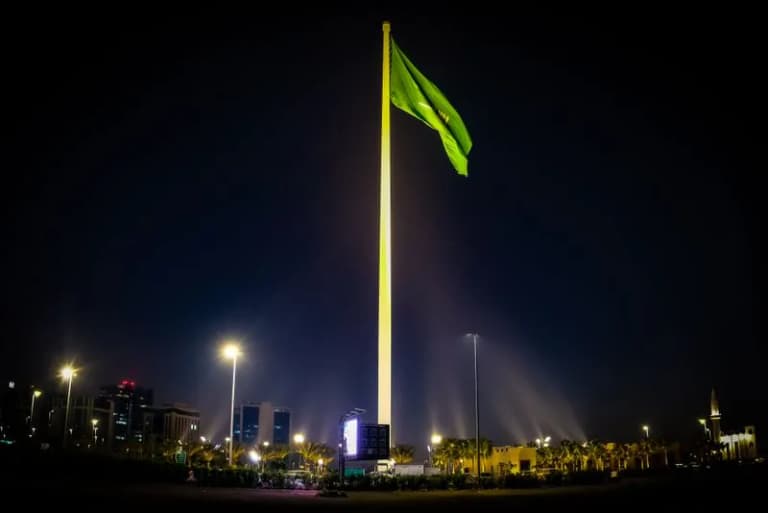
In the days leading up to September 23, the entire country turns green. Buildings, bridges, towers, and landmarks are lit with green lights. The Saudi flag flies from every government building, mall, and many homes. Cars are decorated with flags, stickers, and green ribbons. Shops sell National Day merchandise: green scarves, face paint, temporary tattoos, t-shirts, and accessories. The Riyadh skyline, Jeddah Corniche, and Kingdom Tower are spectacularly illuminated.
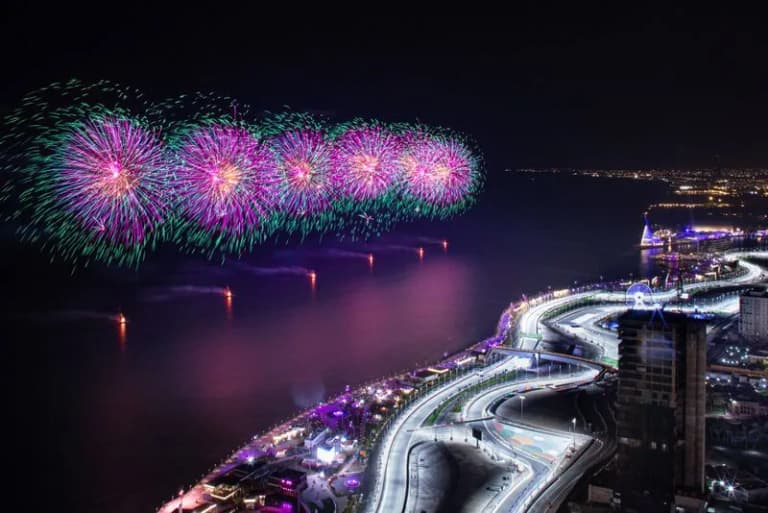
Massive fireworks displays are launched simultaneously across every major city at 9pm on September 23. Riyadh's display, typically launched from multiple locations, is one of the largest in the Middle East. The Saudi Hawks, the Royal Saudi Air Force aerobatic team, perform aerial displays over Riyadh and Jeddah, trailing green and white smoke in the colors of the national flag. Military flyovers by fighter jets are also common.
National Day has become a major entertainment event. The General Entertainment Authority organizes concerts featuring both Saudi and international artists- past performers have included Mohammed Abdo (the "Artist of the Arabs"), Rabeh Saqer, and international acts. Riyadh Season venues host multi-day entertainment programs. Free public events with live music, DJs, and cultural performances take place in parks, squares, and corniche areas across all cities.
Perhaps the most uniquely Saudi tradition: massive spontaneous car paradestake over major roads on the evening of September 23. Thousands of cars decorated with flags and green lights cruise main streets - King Fahd Road in Riyadh and the Corniche in Jeddah become seas of honking, flag-waving, music-blasting vehicles. Young Saudis hang out of car windows waving flags. Traffic essentially stops on major roads, but nobody minds. It's joyful chaos.
Heritage villages and cultural centers host traditional Saudi activities: Ardah sword dancing, traditional coffee and date ceremonies, falconry demonstrations, camel displays, and exhibitions about the Kingdom's history. Museums like the National Museum in Riyadh and the Masmak Fortress offer free or discounted entry. Traditional Saudi food - kabsa, jareesh, margoog - is served at public events.
Major retailers and restaurants offer National Day promotions - discounts of 23% (representing September 23) are common. Hotels offer special packages. Airlines sometimes have promotional fares. Fast food chains and coffee shops create limited-edition green-themed items. Malls extend their hours and organize in-store celebrations.
The capital hosts the largest and most elaborate celebrations in the country, with Boulevard Riyadh City running a multi-day entertainment programme featuring concerts, cultural shows, and food festivals, while King Fahd Road becomes the epicentre of a massive car parade stretching miles through the city centre. Diriyah, the birthplace of the Saudi state, hosts heritage-themed celebrations complete with Ardah performances and historical exhibitions, and major public parks like King Abdullah Park offer family-friendly events with food stalls and prime fireworks viewing spots. The Saudi Hawks aerobatic team typically performs its air show over the northern Riyadh area.
The Red Sea city's celebrations centre on the waterfront, with the Jeddah Corniche hosting fireworks over the sea, food vendors, live music, and its own massive car parade along the coast road. The King Abdullah Fountain, the world's tallest fountain, is lit in green and white for the occasion, and Al-Balad (Historic Jeddah) hosts cultural events within the atmospheric streets of the UNESCO World Heritage old town, while Jeddah Season venues run concerts and entertainment events that draw crowds from across the western region.
Dammam and Khobar host Gulf Corniche celebrations with fireworks and cultural events, and the King Fahd Causeway to Bahrain is decorated in green for the occasion. Abha in the mountains offers celebrations with a unique Asir cultural character, featuring traditional folk performances in the cooler highland weather that makes outdoor events especially enjoyable. Medina hosts more subdued celebrations befitting the holy city, centred on cultural heritage and community gatherings, while AlUla stages heritage-themed events among the ancient Nabataean ruins, creating a striking blend of ancient and modern. Cities like Tabuk, Ha'il, and Najran hold their own regional celebrations with strong local character and traditional performances.
The Ardah (العرضة) is the most iconic cultural symbol of Saudi National Day and arguably the most recognized Saudi tradition worldwide. It is a traditional sword dance that has been performed for centuries across the Arabian Peninsula.
Two rows of men face each other, each carrying a sword. A poet stands in the center reciting traditional poetry (typically about bravery, honor, and tribal pride). Drummers set a rhythmic beat. The men step forward and back in synchronized movements, raising and lowering their swords in unison, while chanting the poetry in chorus. The movements are deliberate and dignified rather than aggressive - the Ardah is about unity, strength, and cultural identity, not combat.
The Ardah originated as a pre-battle ritualperformed by Bedouin warriors to boost morale, demonstrate unity, and intimidate opponents. The poetry recited during the Ardah would praise the tribe's bravery and lineage. Over centuries, it evolved from a military function into a cultural celebration performed at weddings, festivals, and national occasions. King Abdulaziz himself performed the Ardah after military victories during his unification campaigns.
The Najdi Ardah (from central Saudi Arabia) was inscribed on UNESCO's Representative List of the Intangible Cultural Heritage of Humanityin 2015, recognizing its importance as a living tradition. Saudi kings and senior royals regularly participate in Ardah performances at national events - images of King Salman performing the Ardah are iconic. Schools teach the Ardah to students, and National Day celebrations always feature Ardah performances. Different regions have their own variations: the Hejazi Mizmar, the southern Khatwa, and the Eastern Province's Liwa, each with distinct rhythms and movements.
Experiencing the Ardah:
During National Day, look for Ardah performances at heritage villages, cultural centers, Diriyah, and major public celebration sites. Some events invite audience members to join the outer rows - if you get the chance, it's an unforgettable experience. Follow the movements of the person next to you.
The simplest way to join in is to wear something green, whether a shirt, scarf, or accessory, which shows solidarity and is always warmly appreciated by Saudi colleagues and friends. Greeting your Saudi neighbours and colleagues with "Happy National Day" or the Arabic "Kul sana wa antum bikhair" goes a long way, and attending public events is easy since most celebrations are free and open to everyone regardless of nationality. Sharing your National Day experience on social media with the hashtag #اليوم_الوطني_السعودي demonstrates cultural engagement, and you should make sure to try the traditional food served at public events, where many stalls offer free kabsa, Arabic coffee, and dates.
Be warned that traffic will be chaotic on the evening of September 23, as major roads in city centres become informal parade routes, so if you need to drive, avoid main roads entirely or plan to arrive at your destination well before sunset. Government services, banks, and ATMs at bank branches are all closed, so do not plan any official business, Iqama renewals, or government appointments for that day, and make sure to withdraw cash in advance (online banking works normally). The celebrations, including fireworks, car horns, and music, typically continue well past midnight, so keep earplugs handy if you are noise-sensitive. On the positive side, National Day sales and promotions are widespread, with many retailers offering 23% discounts (representing September 23), so it is worth checking for deals on things you need, and popular restaurants fill up for National Day dinner, so reserve a table 2 to 3 days ahead if you want to dine out.
Late September is still hot in most of Saudi Arabia: Riyadh averages 100-104°F (38-40°C), Jeddah 97-100°F (36-38°C), Dammam 95-99°F (35-37°C). However, most National Day events are held in the evening and nighttime when temperatures drop to 82-90°F (28-32°C). Abha and the mountain region will be pleasantly cool at 68-77°F (20-25°C). Bring water, wear light clothing, and pace yourself at outdoor events. See our Saudi Arabia weather guide for details.
Saudi Arabia has relatively few public holidays compared to many countries. Here are all official holidays:
| Holiday | Date | Days Off | Notes |
|---|---|---|---|
| Saudi Founding Day | February 22 | 1 | Commemorates 1727 founding. Established in 2022. |
| Eid al-Fitr | Varies (Islamic calendar) | 4-7 | End of Ramadan. Dates shift ~11 days earlier each year. |
| Eid al-Adha | Varies (Islamic calendar) | 4-7 | Festival of Sacrifice. During Hajj season. |
| Saudi National Day | September 23 | 1 | Unification of the Kingdom in 1932. |
That's it - just four holidays. Saudi Arabia does notobserve New Year's Day, Christmas, or any other Gregorian calendar holidays. The Islamic New Year (1 Muharram) and the Prophet's Birthday (Mawlid) are recognized religiously but are not official public holidays in Saudi Arabia. This means Saudi workers get significantly fewer public holidays than most other countries, which makes Eid and National Day celebrations all the more significant.
Saudi National Day is celebrated on September 23 every year. It commemorates the unification of the Kingdom of Saudi Arabia by King Abdulaziz ibn Abdul Rahman Al Saud (Ibn Saud) on September 23, 1932. In 2026, Saudi Arabia will celebrate its 96th National Day. The date is fixed on the Gregorian calendar, unlike Islamic holidays which follow the lunar Hijri calendar.
Yes, Saudi National Day is an official public holiday. All government offices, banks, schools, and most private sector businesses are closed. If September 23 falls on a weekend (Friday-Saturday), the holiday is typically extended to the nearest working day. Many companies give employees additional days off, and some combine it with the weekend for a long break. Malls, restaurants, and entertainment venues remain open with extended hours and special events.
Saudi National Day is a major celebration across the entire country. Cities are decorated in green (the national color), buildings are lit with green and white lights, and the national flag is displayed everywhere. Major events include massive fireworks displays, air shows by the Saudi Hawks aerobatic team, concerts featuring Saudi and international artists, cultural festivals, traditional sword dances (Ardah), car parades with people waving flags, and special offers from retailers and restaurants. Riyadh, Jeddah, and Dammam host the largest celebrations.
Yes, and it's actually one of the most exciting times to visit. Tourist visa holders can experience the celebrations, which include public concerts, fireworks, cultural events, and a festive atmosphere across all cities. However, expect higher hotel prices and crowded attractions, especially in Riyadh and Jeddah. Book accommodation and flights well in advance. The weather in late September is still hot (95-104°F / 35-40°C in most cities), but events are typically held in the evening and at night when temperatures are more comfortable.
The Ardah (العرضة) is the traditional sword dance of Saudi Arabia and a central element of National Day celebrations. Performed by rows of men carrying swords, moving in synchronized steps to the beat of drums and the chanting of traditional poetry, the Ardah dates back centuries and was originally performed before battle. King Salman is known for participating in the Ardah at national events. During National Day, Ardah performances take place at major public celebrations, cultural festivals, and even in schools and workplaces. It was inscribed on UNESCO's Intangible Cultural Heritage list in 2015.
Green is the dominant color of Saudi National Day, reflecting the Saudi flag. Buildings, bridges, and landmarks are illuminated in green. The Saudi national emblem - two crossed swords beneath a date palm - is prominently displayed. The number representing the anniversary year (e.g., '96' for 2026) appears on decorations, merchandise, and social media. White, representing the shahada inscription on the flag, is the secondary color. Many Saudis wear green clothing or accessories, and cars are decorated with flags and green ribbons.
Many expats embrace Saudi National Day as an opportunity to experience Saudi culture and enjoy the festivities. Companies often organize National Day events for their employees. Wearing green, attending public celebrations, and sharing 'Happy National Day' greetings with Saudi colleagues is appreciated and welcomed. It's a day when national pride is very visible, and participating shows respect for the host country. Many expats share National Day content on social media with the Arabic hashtag اليوم_الوطني_السعودي.
Riyadh hosts the largest celebrations, with events at Boulevard Riyadh City, King Fahd Road (which becomes a massive car parade), and various venues across the capital. The Royal Commission typically organizes a major concert and fireworks display. Jeddah's celebrations center on the Corniche and Jeddah Season venues, with fireworks over the Red Sea. Dammam and Khobar have Corniche events along the Gulf coast. Abha hosts traditional mountain celebrations with a unique local character. AlUla often has heritage-themed events among the ancient ruins.
Culture, history, society, and everything about the Kingdom.
Guide to Eid al-Fitr and Eid al-Adha celebrations, traditions, and tips.
Saudi Arabia's transformation plan and what it means for the future.
Month-by-month guide to visiting Saudi Arabia, including festivals and events.