Loading...
Join our Facebook Group: Join: Expats in Saudi Arabia
Loading...
Complete guide to visiting Mount Uhud in Medina. The Battle of Uhud, Martyrs' Cemetery, Archers' Hill, and everything you need to know for your visit.
By How to Saudi Arabia Editorial Team · Last updated:
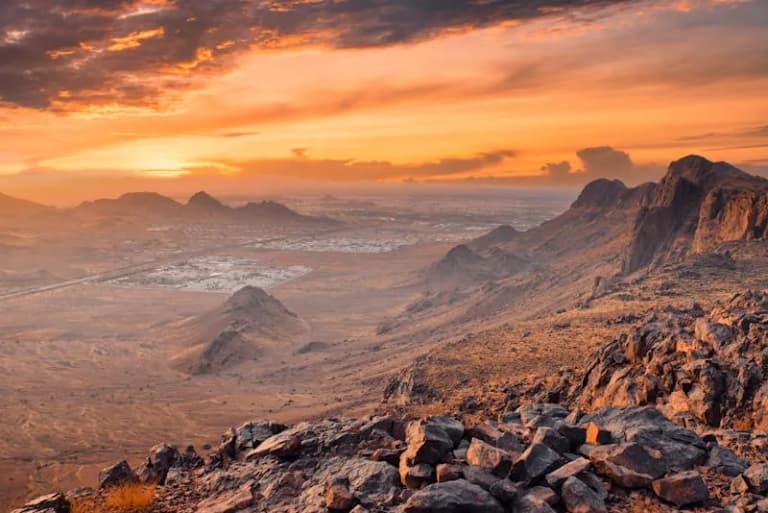
Mount Uhud (Arabic: جبل أحد, Jabal Uhud) is a dramatic mountain ridge of reddish-brown granite that rises to 3,533 feet (1,077 m) above sea level approximately 3 miles (5 km) north of Medina, stretching some 4 miles (7 km) in length across the northern horizon of the city and standing as the largest and most prominent mountain in the entire Medina region.
The mountain is best known as the site of the Battle of Uhud(625 CE), one of the pivotal early battles of Islam in which Muslim forces led by Prophet Muhammad clashed with the Quraysh army of Mecca in a conflict that resulted in significant casualties, including the Prophet's beloved uncle Hamza ibn Abdul-Muttalib, and whose events are so extensively analysed in the Quran that over 60 verses of Surah Al-Imran are dedicated to the lessons drawn from that single day.
Beyond its military history, Prophet Muhammad expressed a remarkably personal connection to the mountain itself, declaring in a famous hadith recorded in Sahih al-Bukhari: "Uhud is a mountain that loves us and we love it,"a statement that has elevated the mountain into a place of deep emotional and spiritual significance for Muslims worldwide and made it one of the most visited sites in Medina after the Prophet's Mosque. The name "Uhud" is derived from the Arabic word for "one" or "uniqueness" (ahad), which scholars believe may refer either to the mountain's solitary prominence in the northern landscape of Medina or to the deeper Islamic concept of the oneness of God (Tawheed).
The Battle of Uhud took place on Saturday, 7 Shawwal 3 AH (March 23, 625 CE) and is one of the most studied and referenced events in Islamic history. Understanding the battle is essential to appreciating the significance of the site.
One year after the Muslim victory at the Battle of Badr, the Quraysh of Mecca assembled a large army of 3,000 soldiers, led by Abu Sufyan ibn Harb, to avenge their defeat and strike at the growing Muslim community in Medina. The Quraysh were supported by their allies and equipped with 200 cavalry and 700 armored warriors. Prophet Muhammad gathered a force of approximately 1,000 Muslims, though 300 withdrew before the battle under the influence of Abdullah ibn Ubayy (a prominent hypocrite), leaving only 700 to face the much larger Quraysh army.
Prophet Muhammad chose to position his army with Mount Uhud at their backs, protecting them from a rear attack. He placed 50 archers on a small hill (Jabal al-Rumah, the Archers' Hill) to the south, commanding them: "Do not leave your position, even if you see birds snatching us away."Their role was critical - they would guard the Muslim army's left flank against the Quraysh cavalry led by Khalid ibn al-Walid (who would later become one of Islam's greatest generals after converting).
The battle began with individual combat (mubarazah), followed by a full engagement. The Muslim fighters initially gained the upper hand, pushing the Quraysh back and overrunning their camp. Seeing victory within reach, most of the archers on the hill abandoned their positionsto collect spoils from the retreating Quraysh camp, despite the Prophet's explicit orders to remain.
Khalid ibn al-Walid seized this critical moment. With his cavalry, he swept around the now-unguarded hill and attacked the Muslim army from behind. Caught between two forces, the Muslim ranks broke into chaos. In the confusion, Prophet Muhammad was struck by a rock that broke his tooth and cut his face. A rumor spread that the Prophet had been killed, causing panic among the Muslim fighters.
The Muslim forces regrouped around the Prophet on the slopes of Mount Uhud, and the Quraysh, instead of pressing their advantage, chose to withdraw. Approximately 70 Muslims were martyred, including Hamza ibn Abdul-Muttalib, the Prophet's uncle and one of the most formidable warriors in early Islam. The Quraysh lost 37 fighters. The battle was a painful lesson that is extensively analyzed in Surah Al-Imran(Quran, Chapter 3, verses 121-179), which addresses the themes of obedience, patience, and the consequences of disobeying the Prophet's commands.
Key lesson of Uhud:
The Battle of Uhud is often cited as a lesson about the dangers of disobedience and the pursuit of worldly gain over spiritual duty. The archers who left their post turned a likely victory into a near-defeat. The Quran states: "Among you are some who desire this world, and among you are some who desire the Hereafter" (3:152).
Several authentic hadiths record Prophet Muhammad's special connection to Mount Uhud. The most famous is narrated in Sahih al-Bukhari: "This is Uhud, a mountain that loves us and we love it." In another narration, when returning to Medina from a journey and seeing Mount Uhud on the horizon, the Prophet said: "This is Taba (Medina), and this is Uhud, a mountain that loves us and we love it." These expressions of love for a physical place are unusual in Islamic tradition, giving Uhud a unique spiritual status.
The approximately 70 companions who fell at Uhud are regarded as shuhada (martyrs) in Islam, guaranteed Paradise according to Islamic belief, and several of them hold particularly prominent places in Islamic memory. The most revered is Hamza ibn Abdul-Muttalib, the Prophet's uncle who was known as "Asad Allah" (Lion of God) and "Sayyid al-Shuhada" (Chief of Martyrs), whose death on the battlefield was said to have caused the Prophet the deepest grief of any loss during his lifetime. Mus'ab ibn Umayr, one of the first ambassadors of Islam sent to Medina, carried the Muslim standard throughout the battle and died defending it rather than let it fall. Abdullah ibn Jahsh, the Prophet's cousin and one of the earliest converts to Islam, also gave his life that day, as did Hanzala ibn Abu Aamir, who earned the remarkable title "Ghaseel al-Mala'ikah" (the one washed by the angels) because he rushed to the battlefield directly from his wedding and, according to Islamic tradition, the angels themselves performed his ritual washing after his martyrdom.
The events at Uhud are extensively discussed in Surah Al-Imran (Quran, Chapter 3), spanning over 60 verses (121-179). These verses analyze the battle, address the causes of the setback, console the believers, and draw lessons about faith, obedience, and trust in God. Verse 169 specifically addresses the status of the martyrs: "And do not think of those who have been killed in the cause of Allah as dead. Rather, they are alive with their Lord, receiving provision."
The Martyrs' Cemetery lies at the foot of Mount Uhud, at the edge of the battlefield. It contains the graves of approximately 70 companions who were martyred in the battle. The graves are simple earth mounds surrounded by a low boundary wall, following the Islamic tradition of modest burial. The grave of Hamza ibn Abdul-Muttalib is the most prominent and most visited. Visitors stand at the wall, face the graves, and offer greetings and supplications for the martyrs - a practice encouraged by Prophet Muhammad himself, who used to visit the site annually.
Jabal al-Rumah(literally "Mountain of the Archers") is the small hill where Prophet Muhammad stationed 50 archers during the battle. It is located about 1,640 feet (500 m) south of Mount Uhud on the open battlefield plain. The hill is modest in size - perhaps 10-15 meters high - but its historical importance is enormous. Standing on this hill, you can clearly see the tactical layout of the battle: Mount Uhud behind the Muslim position, the open plain where the two armies clashed, and the route Khalid ibn al-Walid's cavalry took to outflank the Muslim army. An information board at the site explains the events.
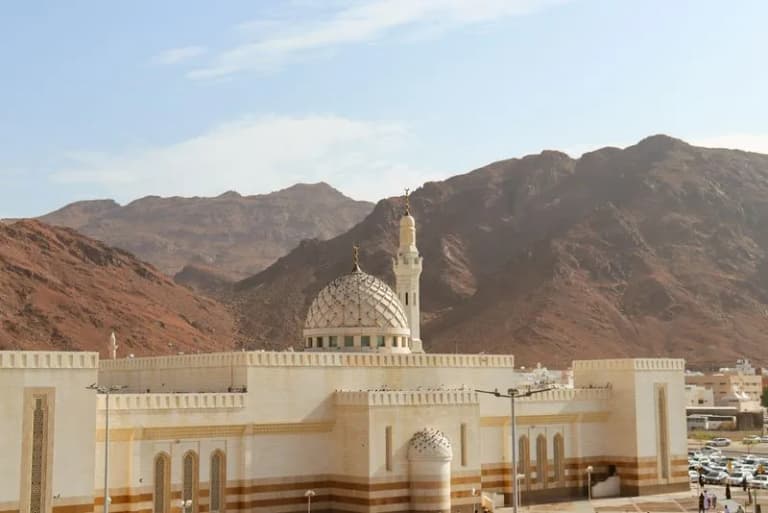
A small mosque located near the Archers' Hill, believed to mark the spot where Prophet Muhammad rested or prayed during the battle. It is a simple structure, and while not a major site, it provides context to the battlefield layout.
The area between Mount Uhud and the Archers' Hill is the actual battlefieldwhere the combat took place in 625 CE. Today, it's partly developed with roads and buildings, but the general geography is recognizable. Walking the plain with knowledge of the battle's progression gives a vivid sense of how the events unfolded - the initial Muslim charge, the premature pursuit of spoils, the cavalry flanking maneuver, and the final regrouping on the mountain slopes.
There is a small cave on the slope of Mount Uhud where, according to some historical accounts, Prophet Muhammad took shelter and had his facial wound treated during the battle. The cave is accessible via a rocky climb, but the path is not formally maintained. Visit with caution and proper footwear.
The lower slopes of Mount Uhud offer excellent viewpoints over Medina and the surrounding date palm oases. The distinctive reddish-brown rock of the mountain creates dramatic scenery, especially during sunrise and sunset when the rock takes on a deep red glow. The mountain's rugged profile against the Medina skyline, with the green dome of the Prophet's Mosque visible in the distance, is one of the most photographed views in the region.
While most visitors come for the historical and religious significance, Mount Uhud also attracts hikers and outdoor enthusiasts. However, this is not a developed hiking destination - there are no formal trails, facilities, or safety infrastructure on the mountain.
The mountain is composed of reddish-brown granite and volcanic rock. The lower slopes are accessible with a moderate scramble over loose rocks and gravel. The terrain becomes progressively steeper and more challenging as you ascend. The summit (3,533 feet / 1,077 m) is reachable but requires a strenuous climb with some exposed sections. There are no water sources, shade, or rescue services on the mountain.
The best season for hiking Mount Uhud is from November through February, when daytime temperatures hover between 59 and 77°F (15 to 25°C) and the conditions are manageable, whereas in summer the exposed rock surface can exceed 140°F (60°C) and any serious exertion becomes genuinely dangerous. Even in winter, aim for early morning between 6 and 9am or late afternoon from 3 to 5pm, and avoid the midday sun entirely. Wear sturdy hiking shoes or boots with good ankle support and grip, as the rock is loose and crumbly in many places, and bring at least 2 to 3 litres of water per person since there are absolutely no water sources on the mountain. Sun protection is essential year-round because there is virtually no shade on the slopes, so pack a hat, sunscreen, and sunglasses regardless of the season. Always tell someone at your hotel your plans and your expected return time, never hike alone, and stick to established paths where you can see them, as some areas have unstable rock that can give way underfoot.
Safety warning:
Mount Uhud is not a maintained hiking area. There are no trail markers, guardrails, or rescue services. Loose rock and steep terrain present genuine falling hazards. Heatstroke is a serious risk in warmer months. If you plan to hike beyond the lower slopes, ensure you have proper equipment, sufficient water, and ideally a local guide.
Mount Uhud and the battlefield area are open 24/7 with no entry fee. The Martyrs' Cemetery area is accessible at all times, though it's best visited during daylight hours. The site is most pleasant in the early morning or late afternoon, when temperatures are comfortable and the light on the mountain is beautiful.
Modest dress is expected throughout the Uhud area. For men: long trousers and a shirt covering the shoulders. For women: loose clothing covering the body and limbs, plus a headscarf. For hiking: sturdy closed-toe shoes are essential. In winter, bring a jacket for early morning visits, as Medina can drop to 46-50°F (8-10°C).
There is a free parking area near the Martyrs' Cemetery, though spaces become limited during peak visiting times such as weekends and the Hajj season, and public restrooms are available near the main visitor area. Small shops and vendors along the road sell water, snacks, dates, and souvenirs, and local guides can be hired at the site for approximately 50 to 100 SAR, offering detailed historical narration of the battle over a 1 to 2 hour walking tour. There is no formal visitor centre at the site, but information boards are posted at key locations to help orient visitors and explain the historical significance of each area.
Visitors should maintain a respectful and quiet demeanour throughout the Uhud area, and this is especially important near the Martyrs' Cemetery, where you should never walk on or step over the graves. Photography is permitted across the site, but it should be done with sensitivity, and posing for selfies directly at the gravesites is considered inappropriate by most visitors and locals. Bring a bag for any rubbish you generate and take it with you when you leave, be mindful of others who may be praying or in a state of spiritual reflection, and do not remove any rocks, stones, or natural materials from the site as souvenirs, as this is both disrespectful and damaging to the historical landscape.
| Season | Temperature | Recommendation |
|---|---|---|
| Winter (Dec-Feb) | 59-77°F (15-25°C) daytime | Best season. Comfortable for walking and hiking. Cool mornings. |
| Spring (Mar-Apr) | 77-95°F (25-35°C) | Good for early morning visits. Gets warm by midday. |
| Summer (May-Sep) | 104-113°F (40-45°C) | Not recommended. Extreme heat makes outdoor activity dangerous. |
| Autumn (Oct-Nov) | 82-95°F (28-35°C) | Acceptable. Early mornings are pleasant. |
Mount Uhud is approximately 3 miles (5 km) north of the Prophet's Mosque in central Medina, and the simplest way to get there is by taxi, Uber, or Careem, which takes 10 to 15 minutes and costs roughly 15 to 30 SAR depending on traffic. Many hotels and tour operators in Medina also offer half-day "Ziyarah" tours that combine Mount Uhud with other historical sites like the Qiblatayn Mosque and Quba Mosque for 50 to 150 SAR per person, which can be a convenient option if you want a guided experience with historical narration. Walking is technically possible but not recommended due to the distance and limited pedestrian infrastructure along the road to Uhud.
Prince Mohammed bin Abdulaziz Airport (MED) is approximately 11 miles (18 km) from Mount Uhud. By taxi, the journey takes 20-30 minutes and costs 60-100 SAR.
Most visitors combine Mount Uhud with other Medina historical sites in a single day trip, and a typical itinerary might begin with a morning visit to Mount Uhud and the Martyrs' Cemetery lasting about 1.5 to 2 hours, followed by a brief stop at Masjid al-Qiblatayn around midday, then an afternoon visit to Quba Mosquefor about an hour, before returning to the Prophet's Mosque in the evening for Maghrib prayer and a visit to the Jannat al-Baqi cemetery.
Getting to Medina:
Medina is accessible by air (direct flights from Riyadh, Jeddah, and international destinations), by the Haramain High-Speed Railway (from Mecca and Jeddah), and by road. See our Medina city guide for full transportation details.
Yes, non-Muslims can visit Mount Uhud and the surrounding area. Unlike Mecca, the city of Medina is open to visitors of all faiths, and Mount Uhud is located on the outskirts of the city. Non-Muslims can visit the battlefield, the Martyrs' Cemetery viewpoint, and hike on the mountain. However, modest dress and respectful behavior are expected at all times, as it is a site of deep religious significance.
A basic visit to the Mount Uhud area - including the battlefield site, the Martyrs' Cemetery, and the nearby mosque - takes about 1-2 hours. If you want to hike partway up the mountain for views, add another 1-2 hours depending on how far you climb. There are no formal hiking trails to the summit, and climbing to the top is not recommended without a guide. Most organized tours of Medina's historical sites allocate about 1.5 hours for the Uhud area.
The lower slopes of Mount Uhud are accessible and relatively safe for casual hiking. The terrain is rocky with loose gravel, so sturdy footwear is essential - don't attempt it in sandals. There are no formal trails, guardrails, or safety infrastructure on the mountain itself. The higher slopes become steep and dangerous. Climbing to the summit (3,533 feet / 1,077 m) is not recommended for casual visitors. In summer, the heat makes any significant hiking dangerous - bring at least 2 liters of water per person and avoid climbing between 10am and 4pm.
Mount Uhud holds immense significance in Islam. Prophet Muhammad said: 'Uhud is a mountain that loves us and we love it.' The Battle of Uhud (625 CE) was one of the most important early Islamic battles, where the Muslim army faced the Quraysh of Mecca. The Prophet's uncle Hamza ibn Abdul-Muttalib, known as the 'Lion of God,' was martyred here along with about 70 other companions. The battle taught crucial lessons about obedience and faith that are referenced in the Quran (Surah Al-Imran, 3:121-179).
The Archers' Hill (Jabal al-Rumah, also called Jabal Ainain) is a small hill located on the battlefield plain, about 1,640 feet (500 m) south of Mount Uhud. It's where Prophet Muhammad stationed 50 archers during the Battle of Uhud with strict orders not to leave their position. When most archers disobeyed this order to collect war spoils, the Quraysh cavalry flanked the Muslim army, turning the tide of battle. The hill is clearly marked and accessible, with a small mosque (Masjid al-Fasah) nearby. It's an essential stop for understanding the battle.
Modest clothing is expected as Mount Uhud is a site of religious significance. Men should wear long trousers and shirts covering the shoulders. Women should wear loose-fitting clothing covering the body and limbs, plus a headscarf. For the mountain itself, wear sturdy closed-toe shoes with good grip - the terrain is rocky and uneven. In summer, lightweight, breathable fabrics in light colors are essential, plus a hat and sunscreen. In winter (December-February), bring a warm jacket as Medina mornings can be cool (46-54°F / 8-12°C).
No, there is no entrance fee to visit Mount Uhud, the battlefield, or the Martyrs' Cemetery area. The site is open to the public at all times. There are no formal opening or closing hours for the mountain and battlefield area, though the small mosques nearby follow regular prayer time schedules. Some visitors hire local guides (available at the site for approximately 50-100 SAR) who can provide detailed historical narration of the battle.
You can visit the Martyrs' Cemetery (Shuhada Uhud) and view the graves from outside the boundary wall. The cemetery contains the graves of about 70 companions who were martyred in the Battle of Uhud, including Hamza ibn Abdul-Muttalib (the Prophet's uncle) and Mus'ab ibn Umayr. The graves are simple earth mounds without elaborate tombstones, following Islamic tradition. Visitors should not sit on or step over graves, and should make dua (supplication) for the martyrs. Photography is permitted but should be done respectfully.
The first mosque in Islam - history, significance, and visiting information.
Complete guide to the Grand Mosque in Mecca.
Accommodation, transport, dining, and all sites in Medina.
How to apply for an Umrah visa and plan your pilgrimage.