Loading...
Join our Facebook Group: Join: Expats in Saudi Arabia
Loading...
Everything you need to know about visiting Quba Mosque in Medina. History, spiritual significance, architecture, and practical tips for your visit.
By How to Saudi Arabia Editorial Team · Last updated:
Quba Mosque (Arabic: مسجد قباء, Masjid Quba) holds a distinction that no other mosque in the world can claim: it is the first mosque ever constructed in Islam, founded by Prophet Muhammad himself in 622 CE on the southern outskirts of Medina upon his arrival from Mecca during the Hijra, the defining migration that marks the beginning of the Islamic calendar.
The Quran directly references the mosque in Surah At-Tawbah (9:108) as "a mosque founded on righteousness from the first day," a Quranic endorsement that few other mosques in the world can claim, and Prophet Muhammad made it his habit to visit Quba Mosque regularly, particularly on Saturdays, teaching that praying there carries the spiritual reward equivalent to performing an Umrah - a tradition that continues to draw millions of visitors to its doors every year.
Following a massive expansion completed in recent years, Quba Mosque has grown into one of the largest mosques in the world with a capacity exceeding 70,000 worshippers, yet despite its modern grandeur it retains the historical and spiritual essence of the humble place where the first Muslim community gathered to pray more than 1,400 years ago.
In September 622 CE, Prophet Muhammad left Mecca to escape persecution and journeyed to Medina in what is known as the Hijra - the defining event of Islamic history from which the Islamic calendar begins. Before reaching the city center of Medina, he stopped in the village of Quba, where he stayed for approximately 14 days with the Banu Amr ibn Awf clan.
During his stay, the Prophet laid the foundation stones of a mosque with his own hands. The early Muslim community helped construct it using palm trunks as pillars and palm fronds as roofing. This simple structure became the first purpose-built mosque in Islamic history. The Prophet prayed the first congregational Jumu'ah (Friday) prayer here before continuing to central Medina, where he would later build Masjid an-Nabawi (the Prophet's Mosque).
Like many great historical mosques, Quba Mosque has been rebuilt and expanded numerous times throughout its long history. Caliph Uthman ibn Affan (644-656 CE) was the first to carry out a major renovation, replacing the original palm-trunk-and-frond structure with stone and adding a formal mihrab (prayer niche) to indicate the qibla direction. During the Umayyad period in the 8th century, further expansions added a minaret, a proper courtyard, and more durable construction materials, while the Abbasid and Mamluk periods saw periodic renovations to maintain the structure, including complete rebuilds after damage from floods and earthquakes.
In the Ottoman period, Sultan Mahmud II renovated the mosque in 1829 and introduced Ottoman architectural elements, and then in 1986 a major Saudi-funded reconstruction completely rebuilt the mosque from the ground up in a modern Islamic style, increasing its capacity to 20,000 worshippers and creating the elegant structure that would serve as the foundation for the recent mega-expansion.
The Quran directly references Quba Mosque in Surah At-Tawbah (9:108): "...A mosque founded on righteousness from the first day is more worthy for you to stand in. Within it are men who love to purify themselves; and Allah loves those who purify themselves." Islamic scholars overwhelmingly identify this verse as referring to Quba Mosque, cementing its place as a mosque built upon taqwa (God-consciousness) from its very inception.
Quba Mosque holds a unique spiritual status in Islam, ranked among the most sacred mosques after Masjid al-Haram in Mecca and Masjid an-Nabawi in Medina.
The most frequently cited hadith about Quba Mosque comes from Sahl ibn Hanif, who reported that Prophet Muhammad said: "Whoever purifies himself in his house, then comes to Masjid Quba and prays there, he will have a reward like that of an Umrah."(Sunan an-Nasa'i, Sunan Ibn Majah). This hadith means that performing wudu (ritual ablution) at home and then traveling to Quba Mosque specifically to pray two rak'ahs earns a reward equivalent to performing the lesser pilgrimage. This extraordinary reward is a major reason why Quba Mosque attracts such large numbers of visitors.
Prophet Muhammad made it a habit to visit Quba Mosque every Saturday, sometimes walking and sometimes riding. This practice (Sunnah) is followed by millions of Muslims who visit on Saturdays in emulation of the Prophet. The hadith literature records that he would perform two rak'ahs of prayer upon arriving. This regular visitation by the Prophet himself, even after establishing Masjid an-Nabawi in central Medina, underscores the continuing importance he placed on this first mosque.
An interesting historical note: during the early period of Islam, Muslims initially prayed facing Jerusalem (Bayt al-Maqdis). The command to change the qibla (prayer direction) to the Kaaba in Mecca was revealed while Muslims were praying. Masjid al-Qiblatayn ("Mosque of the Two Qiblas"), located nearby in Medina, marks where this change occurred. Quba Mosque was among the first mosques to adopt the new qibla direction.
The three holiest mosques in Islam:
While Quba Mosque is not ranked among the top three, its unique Umrah-equivalent reward and its status as the first mosque give it a special place in Islamic sacred geography.
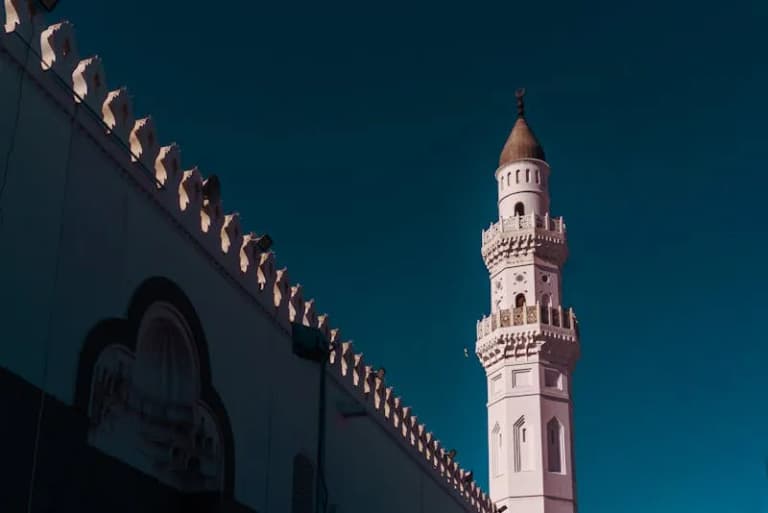
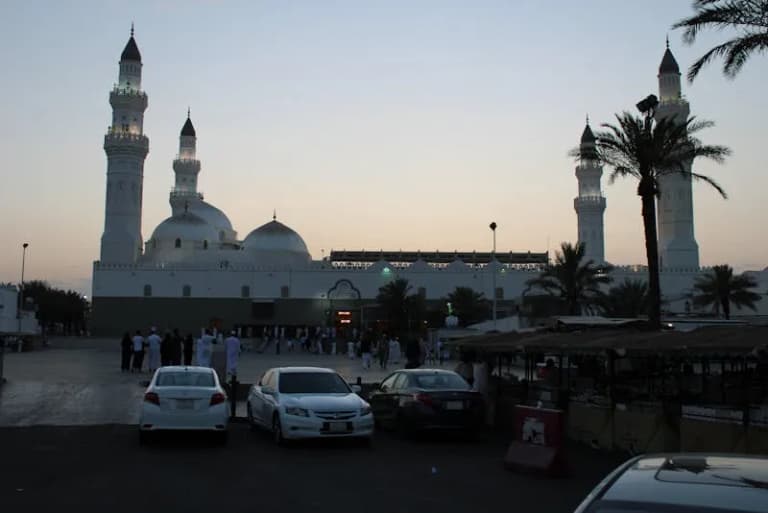
The current Quba Mosque is a stunning example of modern Islamic architecture that successfully blends traditional elements with contemporary design and engineering on a truly grand scale.
The core structure that formed the basis for the recent expansion was built in 1986 under the direction of Egyptian architect Abdel-Wahed El-Wakil, one of the most celebrated Islamic architects of the 20th century. His design centred on a prayer hall crowned by 56 small domes supported by marble columns, with six larger domes positioned over the main prayer areas and four minarets rising 154 feet (47 m) at the corners, while shaded colonnades surrounded the courtyards and traditional Islamic geometric patterns in stone and plaster adorned the surfaces throughout, creating a space that could accommodate approximately 20,000 worshippers.
The mosque makes extensive use of white marble and granite, which gives the entire complex a luminous appearance that contrasts beautifully with the date palms surrounding it. Inside, the prayer halls feature ornate chandeliers, hand-woven carpets, and air conditioning throughout, while the minarets follow a modernized Ottoman-Hejazi style with balconies from which the adhan (call to prayer) is broadcast across the neighbourhood. The courtyard includes a sunken garden with fountains and seating areas shaded by palm trees, creating a contemplative atmosphere that invites visitors to linger.
The mihrab (prayer niche indicating the qibla direction) is located at the spot believed to be where Prophet Muhammad himself prayed, and it is elaborately decorated with marble inlay, calligraphy, and geometric patterns. A small area near the mihrab marks the approximate location where the Prophet laid the original foundation stones of the mosque, making it a particularly popular spot among visitors who come to offer voluntary prayers at the very place where Islamic congregational worship began.
In 2022, Crown Prince Mohammed bin Salman announced a massive expansion of Quba Mosque as part of the broader development of Medina under Vision 2030. This expansion is one of the largest mosque construction projects in the world.
The expansion has increased the mosque's capacity from 20,000 to over 70,000 worshippers, with a total prayer area of approximately 538,000 square feet (50,000 sq m) that includes new prayer plazas and courtyards surrounding the main structure, retractable shading structures and giant umbrellas for the outdoor prayer areas, and modern amenities including improved ablution facilities, advanced cooling systems, and comprehensive accessibility features. The project also encompasses landscaped gardens and pedestrian pathways that connect the mosque to surrounding neighbourhoods, underground parking facilities, and careful integration with the broader Medina urban development plan to ensure the mosque functions as a seamless part of the city's future.
The expansion preserves the original 1986 structure at its core while extending the mosque in all directions. The new sections use similar materials (white marble and granite) and architectural vocabulary to maintain visual harmony. Sustainable design elements include solar panels, water recycling systems, and energy-efficient cooling. The project also includes the development of the surrounding Quba district, with improved pedestrian access, commercial facilities, and green spaces.
Quba Mosque is open 24 hours a day, every day of the year. There are no tickets or reservations required. You can visit at any time, though the mosque is busiest during and immediately after the five daily prayer times.
Saturday mornings hold special significance because the Prophet himself visited Quba Mosque every Saturday, and many Muslims follow this practice, so expect larger crowds if you choose this day. For a quieter and more contemplative experience, weekday morningsbetween the Fajr and Dhuhr prayers are ideal, as the mosque is relatively uncrowded and the morning light fills the courtyards beautifully. Evening visits after Isha prayer are also worthwhile because the mosque is strikingly illuminated at night, creating an atmospheric setting for prayer and reflection. You should generally avoid Friday afternoons, when the Jumu'ah prayer draws the largest crowds of the week, and Ramadan evenings, when the mosque becomes extremely busy with worshippers breaking their fast and performing Tarawih prayers.
To earn the full Umrah-equivalent reward mentioned in the hadith, make sure to perform wudu (ablution) at your home or hotel before setting out for the mosque, as this is a specific condition of the hadith narrated by Sahl ibn Hanif. Upon entering the mosque, pray two rak'ahs of Tahiyyat al-Masjid (the greeting prayer of the mosque), then make your way to the mihrab area, which marks the approximate location where the Prophet himself prayed and where many visitors find it particularly moving to offer their supplications. After praying, take time to explore the beautifully landscaped courtyards and gardens that surround the main prayer halls, drink Zamzam water from the coolers placed throughout the complex, and spend some moments in quiet dhikr (remembrance of God) and personal dua (supplication), as the peaceful atmosphere of this historic mosque is uniquely conducive to spiritual reflection.
Men: Long trousers or thobe, shirt covering shoulders. Shorts above the knee are not appropriate. Women: Full-length abaya or loose clothing covering body and limbs, plus headscarf. Shoes are removed before entering prayer areas - bring slip-on shoes and consider carrying them in a bag inside.
Quba Mosque provides separate prayer halls for men and women, each equipped with modern ablution areas offering both hot and cold water, clean restroom facilities, and Zamzam water coolers on all levels. The mosque is fully accessible for visitors with reduced mobility, with ramps and elevators connecting all floors, and shoe storage areas are available at each entrance, though bringing a plastic bag for your shoes is advisable during busy periods. The surrounding area has a range of small shops selling prayer items, dates, and souvenirs, as well as food vendors and restaurants, and a multi-story car park provides parking for those arriving by car.
Quba Mosque is approximately 3 miles (5 km) south of the Prophet's Mosque, and the quickest way to get there is by taxi, Uber, or Careem, which takes about 10 to 15 minutes and costs roughly 15 to 25 SAR depending on traffic conditions. Many visitors choose to walk the route along Quba Road, a journey of 45 to 60 minutes that passes through shops, restaurants, and date palm gardens, and that is particularly pleasant during the cooler winter months from November to February, though it is not advisable in the intense summer heat. City buses also run along the Quba route at regular intervals, so check with your hotel reception for the nearest bus stop.
Medina's airport is approximately 9 miles (15 km) north of Quba Mosque. By taxi, the journey takes 20-30 minutes and costs approximately 50-80 SAR. Ride-hailing apps are available at the airport.
From Mecca, you can reach Medina in about 4 to 4.5 hours by car via the Hijra Road, or more comfortably by the Haramain High-Speed Railway, which takes you to Medina station in around 2.5 hours, from where a short taxi ride brings you to Quba Mosque. From Jeddah, the drive takes approximately 4 hours, or you can take the Haramain train to Medina station in about 2 hours. From Riyadh, domestic flights to Prince Mohammed bin Abdulaziz Airport take roughly 1.5 hours and are the most practical option, though driving via Highway 60 is possible if you have 8 to 9 hours to spare.
Combining visits:
Most visitors to Medina combine a visit to Quba Mosque with the Prophet's Mosque and other historical sites like Mount Uhud, Masjid al-Qiblatayn, and the Jannat al-Baqi cemetery. A full day is usually sufficient to visit all major Medina sites.
Medina is rich with Islamic historical sites. Here are the most significant places to visit near Quba Mosque:
The second holiest mosque in Islam, built by Prophet Muhammad himself. It houses the Rawdah ash-Sharifah(the Noble Garden), the area between the Prophet's tomb and his pulpit, considered one of the gardens of Paradise. The mosque's iconic green dome marks the location of the Prophet's burial place. Open to visitors of all faiths (except the main prayer hall). Located 3 miles (5 km) north of Quba Mosque.
The site of the Battle of Uhud (625 CE), one of the most significant early Islamic battles. The mountain and the battlefield at its base are a major pilgrimage site. The Uhud Mountain area includes the Shuhada (Martyrs) Cemetery, where companions of the Prophet who fell in battle are buried. Located approximately 4 miles (7 km) north of Quba Mosque.
The "Mosque of the Two Qiblas" marks the location where the revelation to change the prayer direction from Jerusalem to Mecca was received. The mosque originally had two mihrabs - one pointing to Jerusalem and one to Mecca. It has been renovated with a modern design. Located approximately 2.5 miles (4 km) northwest of Quba Mosque.
The main cemetery of Medina, located adjacent to Masjid an-Nabawi. It is the burial place of many of the Prophet's companions, family members, and wives, including Uthman ibn Affan (the third Caliph), Fatimah (the Prophet's daughter, according to some traditions), and Aisha. The cemetery is open to male visitors after certain prayers.
Medina is famous for its dates, particularly the prized Ajwa variety. The area around Quba has numerous date palm gardens, and the central Medina date market offers dozens of varieties for purchase. Buying Medina dates as gifts is a tradition for visitors. The Quba area itself is surrounded by some of the oldest date palm orchards in the city.
Yes, non-Muslims can visit Quba Mosque and the city of Medina. Unlike Mecca, which is restricted to Muslims only, Medina is open to visitors of all faiths. Non-Muslims can enter Quba Mosque, walk around the grounds, and appreciate the architecture. However, non-Muslims cannot enter the main prayer hall of Masjid an-Nabawi (the Prophet's Mosque) in central Medina. At Quba Mosque, respectful behavior and modest dress are expected from all visitors regardless of religion.
According to a hadith narrated by Ibn Majah, Prophet Muhammad said: 'Whoever purifies himself in his house, then comes to Quba Mosque and prays there, he will have a reward like that of an Umrah.' This means performing wudu (ablution) at home and then praying two rak'ahs at Quba Mosque earns a spiritual reward equivalent to performing the lesser pilgrimage (Umrah). This hadith makes Quba Mosque one of the most spiritually significant mosques in Islam after Masjid al-Haram and Masjid an-Nabawi.
Quba Mosque is approximately 3 miles (5 km) south of Masjid an-Nabawi (the Prophet's Mosque) in central Medina. By car or taxi, the journey takes about 10-15 minutes depending on traffic. Many visitors walk the route, which takes about 45-60 minutes along the well-maintained Quba Road. The walk is pleasant during winter months but not recommended in summer heat. Local buses and ride-hailing apps (Uber, Careem) are also available.
Quba Mosque is open 24 hours a day, 7 days a week, throughout the year. You can visit at any time. The mosque is busiest during and immediately after the five daily prayer times, especially Dhuhr (noon) and Maghrib (sunset) prayers. Saturday mornings are particularly crowded as it was the Prophet's custom to visit Quba Mosque on Saturdays. For a quieter experience, visit on weekday mornings between Fajr and Dhuhr prayers.
Yes, there is a large parking area adjacent to Quba Mosque. However, during peak times (Friday prayers, weekends, Ramadan, and Hajj season), parking can be very difficult to find. During busy periods, consider taking a taxi or ride-hailing service. The surrounding area also has some street parking, though it fills up quickly. A multi-story car park was built as part of the recent expansion project.
Saturday holds special significance because Prophet Muhammad used to visit Quba Mosque every Saturday, either walking or riding. Many Muslims follow this Sunnah (prophetic tradition) and visit on Saturdays, making it the busiest day. If you want the spiritual significance of a Saturday visit, go early in the morning. For a quieter experience, weekday mornings (Sunday through Thursday) are best. During Ramadan, the mosque is crowded throughout but the atmosphere is particularly spiritual.
Modest clothing is required. For men, long trousers or a thobe and a shirt covering the shoulders. Shorts above the knee are not appropriate. For women, a full-length abaya or loose clothing covering the body, arms, and legs, plus a headscarf covering the hair. Shoes are removed before entering the prayer areas. Bring slip-on shoes for convenience, and consider carrying a shoe bag as shoe storage areas can be crowded. Clean socks are recommended as the marble floors can be cold in winter.
Yes, Quba Mosque is widely regarded as the first mosque built in Islam. When Prophet Muhammad arrived in Quba (on the outskirts of Medina) during his Hijra (migration) from Mecca in 622 CE, he personally laid the first stones and participated in its construction before continuing to Medina to build Masjid an-Nabawi. The Quran references Quba Mosque in Surah At-Tawbah (9:108): 'A mosque founded on righteousness from the first day is more worthy for you to stand in.' This Quranic mention adds to its immense spiritual significance.
Complete guide to the Grand Mosque in Mecca - history, Kaaba, Tawaf, and practical tips.
The Battle of Uhud, visiting the mountain, and the Martyrs' Cemetery.
How to apply for an Umrah visa and plan your pilgrimage.
Complete guide to Medina - accommodation, transport, dining, and sites.